
A3209Ex and A3210Ex integrated circuits are ultra-sensitive, pole independent Hall-effect switches with a latched digital output. They are especially suited for operation in battery-operated, hand-held equipment such as cellular and cordless telephones, pagers, and palmtop computers. 2.5 volt to 3.5 volt operation and a unique clocking scheme to reduce the average operating power requirements - the A3209Ex to 400 µW, the A3210Ex to 25 µW! Except for operating duty cycle and average operating current, the A3209Ex and A3210Ex are identical. Unlike other Hall-effect switches, either a north or south pole of sufficient strength will turn the output on; in the absence of a magnetic field, the output is off. The polarity independence and minimal power requirement allows these devices to easily replace reed switches for superior reliability and ease of manufacturing, while eliminating the requirement for signal conditioning. Improved stability is made possible through chopper stabilization (dynamic offset cancellation), which reduces the residual offset voltage normally caused by device overmolding, temperature dependencies, and thermal stress. These devices include on a single silicon chip a Hall-voltage generator, small-signal amplifier, chopper stabilization, a latch, and a MOSFET output. Advanced BiCMOS processing is used to take advantage of low-voltage and low-power requirements, component matching, very low input-offset errors, and small component geometries. The A3209Ex and A3210Ex are available in DIP-8 or SMD-8 packages.
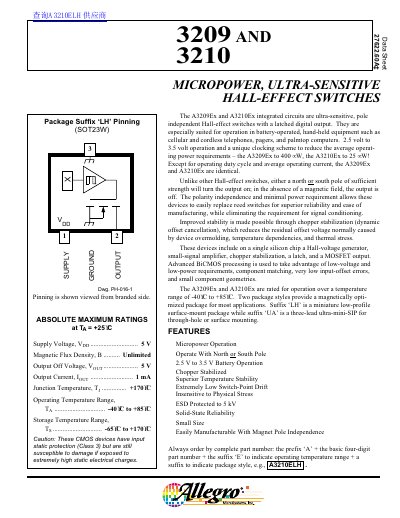
This document describes the A3209Ex and A3210Ex integrated circuits, which are ultra-sensitive, pole-independent Hall-effect switches with a latched digital output. These devices are designed for battery-operated, hand-held equipment such as cellular phones, pagers, and palmtop computers, offering low power consumption and high reliability.
| Supply Voltage Range | 2.5 V to 3.5 V |
|---|---|
| Operate Point (South pole) | -30 G to 60 G |
| Release Point (South pole) | 5.0 G to 22 G |
The devices operate with a supply voltage range of 2.5 V to 3.5 V.
No, either a north or south pole of sufficient strength will turn the output on.