
Hanna HI 38023 Total Chlorine Extended Range Test Kit is a tool for detecting total chlorine content in water. It contains potassium iodide solution, sulfamic acid reagent, starch indicator, sodium thiosulfate reagent, 50ml calibrated plastic vessel, 1ml syringe, 1ml plastic pipette, 1 spoon.
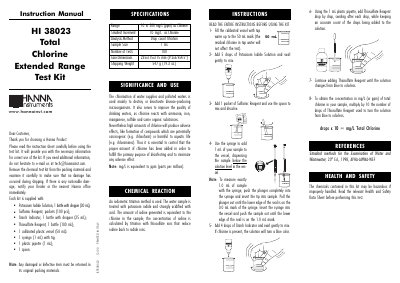
This document is an instruction manual for the Hanna Instruments HI 38023 Total Chlorine Extended Range Test Kit. The kit includes reagents such as Potassium Iodide Solution, Sulfamic Reagent, Starch Indicator, and Thiosulfate Reagent, along with calibrated vessels and syringes for water testing.
The manual explains the iodometric titration method used to measure total chlorine in water samples ranging from 10 to 200 mg/L. It provides step-by-step instructions on how to prepare the sample, add reagents, count drops of thiosulfate required to neutralize the color change, and calculate the final concentration.
| Range | 10 to 200 mg/L (ppm) as Chlorine |
|---|---|
| Smallest Increment | 10 mg/L as Chlorine |
| Analysis Method | Drop count titration |
| Sample Size | 1 mL |
| Number of Tests | 100 |
The kit measures total chlorine in a range from 10 to 200 mg/L (ppm).
Multiply the number of drops of Thiosulfate Reagent used by 10.
The kit uses an iodometric titration method involving drop count titration.