
Agilent Pursuit family and Agilent HC(2)/TC(2) columns provide you with reliable alternatives that will meet the demands of your HPLC applications. The Pursuit family includes general-purpose C18 and C8 phases, as well as special Diphenyl and PFP phases; our HC(2)/TC(2) columns provide a simple, reliable choice for most routine applications.
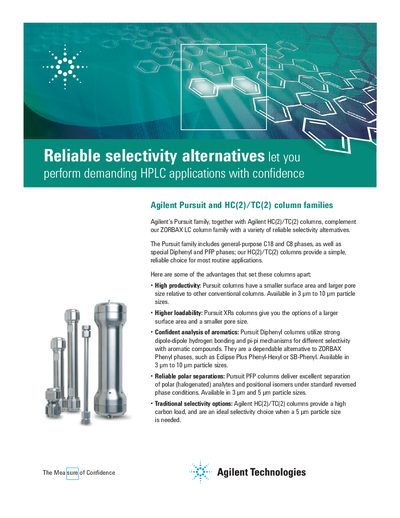
This document introduces the Agilent Pursuit family of HPLC columns, which complement the ZORBAX LC family with reliable selectivity alternatives. The family includes general-purpose C18 and C8 phases, as well as special Diphenyl and PFP phases designed for confident analysis of aromatics and polar separations. Additionally, the HC(2) and TC(2) columns are presented as a simple, reliable choice for routine applications requiring high carbon load.
| Particle Size | 3 um to 10 um |
|---|---|
| Pore Size (Pursuit XRs) | 100A |
| Surface Area (Pursuit XRs) | 440 m2/g |
| Carbon Load (Pursuit XRs C18) | 22% |
| Carbon Load (Pursuit XRs Ultra C18) | 23.2% |
They offer high productivity with smaller surface area and larger pore size, and higher loadability with Pursuit XRs columns.
They utilize strong dipole-dipole hydrogen bonding and pi-pi mechanisms for different selectivity with aromatic compounds.
The columns are available in particle sizes ranging from 3 um to 10 um.