
This application note describes how to use the Agilent Cary Eclipse fluorescence spectrophotometer to monitor fluorescence resonance energy transfer (FRET) between GFP fusions in lysates of the yeast Saccharomyces cerevisiae.
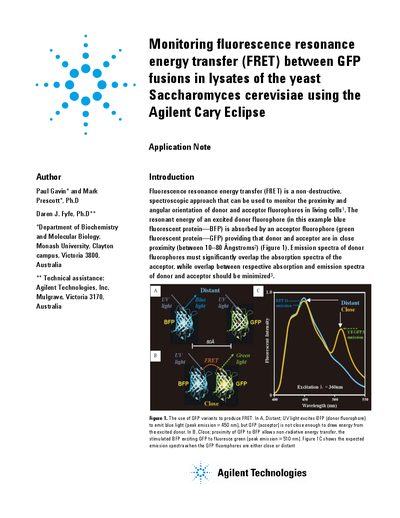
This document details a study using the Agilent Cary Eclipse Fluorescence Spectrophotometer to monitor fluorescence resonance energy transfer (FRET) between blue fluorescent protein (BFP) and green fluorescent protein (GFP) fusions in lysates of the yeast Saccharomyces cerevisiae. The study aims to demonstrate the instrument's ability to detect protein interactions and conformational changes at the protein level within living cells.
| Excitation wavelength for BFP | 360 nm |
|---|---|
| Emission scan range | 400-550 nm |
| Temperature control setting | 25 °C |
| Sample volume | 10 ul |
The Agilent Cary Eclipse Fluorescence Spectrophotometer is used to monitor FRET.
The peptide linker is cleaved by the addition of trypsin after the initial scan.
A green peak at approximately 510 nm indicates successful FRET.