
The ADG419 is a type of analog switch. The characteristics of ADG419 are low power consumption, high switching speed, low switching resistance and low leakage current. ADG419 is suitable for portable and battery powered instruments.
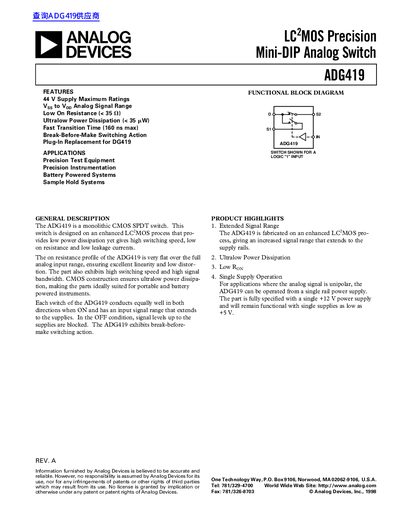
The ADG419 is a monolithic CMOS SPDT switch designed on an enhanced LC MOS process. It provides low power dissipation, high switching speed, low on-resistance, and low leakage currents, making it suitable for precision test equipment and battery-powered systems. The device exhibits break-before-make switching action and conducts equally well in both directions when ON.
| On Resistance (Ron) | < 35 Ω |
|---|---|
| Power Dissipation | < 35 pW |
| Transition Time | 160 ns max |
| Supply Voltage Range | ±44 V |
| Analog Signal Range | Vss to Vpp |
| Operating Temperature (Industrial) | -40°C to +85°C |
| Operating Temperature (Extended) | -55°C to +125°C |
The ADG419 exhibits break-before-make switching action.
It is designed for precision test equipment, precision instrumentation, battery powered systems, and sample hold systems.
Yes, it can be operated from a single rail power supply, fully specified with a single +12 V power supply.