
This is a 24-bit AD7710 analog front end with 24 bits of no missing codes, 1-128 programmable gain front end, differential inputs, low-pass filter, programmable filter cutoffs, ability to read/write calibration coefficients, bidirectional microcontroller serial interface, internal/external reference option, single or dual supply operation and low power (25 mW typical).
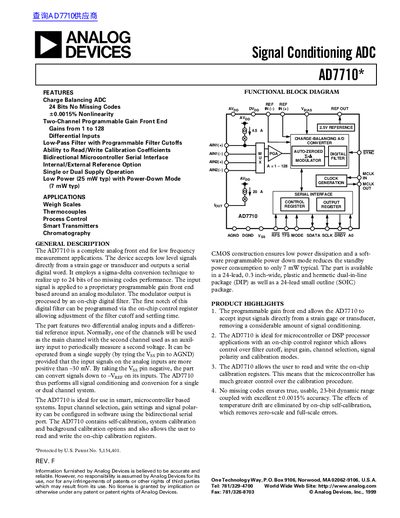
The AD7710 is a complete analog front-end designed for low-frequency measurement applications. It accepts low-level signals directly from strain gauges or transducers and outputs a serial digital word using a sigma-delta conversion technique to achieve up to 24 bits of no missing codes performance.
The device features two differential analog inputs, a programmable gain front end with gains from 1 to 128, and an internal low-pass filter with programmable cutoffs. It includes self-calibration options and allows users to read/write on-chip calibration coefficients via a bidirectional microcontroller serial interface.
| Resolution (No Missing Codes) | 24 Bits min |
|---|---|
| Integral Nonlinearity | +0.0015 % of FSR max |
| Gain Range | 1 to 128 |
| Power Consumption (Typ) | 25 mW |
| Package Type | 24-lead DIP or SOIC |
| Input Common-Mode Rejection | 100 dB min |
The programmable gain front end allows gains from 1 to 128.
Yes, by taking the Vss pin negative, the part can convert signals down to -Vref on its inputs.
The device operates at 25 mW typical with a power-down mode reducing it to 7 mW typical.