
This article introduces the LTM4606 and LTM4612 µModule regulators, which have ultralow conducted and radiated noise, high efficiency and high power density.
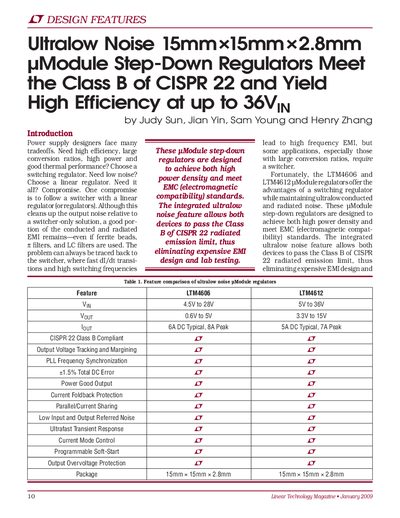
The document introduces the LTM4606 and LTM4612 Module step-down regulators, which are designed to achieve high power density while meeting EMC (electromagnetic compatibility) standards. These devices feature an integrated ultralow noise capability that allows them to pass the Class B of CISPR 22 radiated emission limit without requiring expensive EMI design or lab testing.
Both parts offer good thermal performance and include built-in features such as controllable soft-start, RUN pin control, output voltage tracking and margining, PGOOD indicator, frequency adjustment, and external clock synchronization. The LTM4606 delivers up to 6A DC typical current with an input range of 4.5V to 28V, while the LTM4612 provides up to 5A DC typical from a 5V to 36V input.
| Input Voltage (LTM4606) | 4.5V to 28V |
|---|---|
| Output Voltage Range (LTM4606) | 0.6V to 5V |
| Output Current (Typical) LTM4606 | 6A DC |
| Package Dimensions | 15mm x 15mm x 2.8mm |
| EMI Compliance | CISPR 22 Class B |
Yes, they are designed to achieve both high power density and meet EMC (electromagnetic compatibility) standards.
Yes, the integrated ultralow noise feature allows them to pass the Class B of CISPR 22 radiated emission limit.
The LTM4606 runs at a 900kHz switching frequency.