
This design note introduces a high efficiency two-phase boost converter that minimizes input and output current ripple. The converter uses the LTC1871-7 synchronous buck controller, operating at 300kHz with an output voltage of 24V and an output current of 10A.
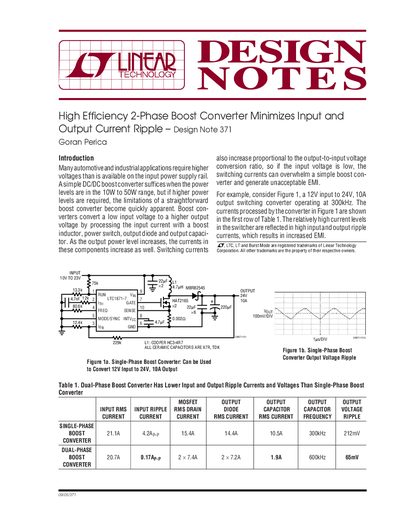
The document discusses the limitations of simple DC/DC boost converters in automotive and industrial applications requiring higher power levels, specifically regarding high switching currents that generate unacceptable EMI. It introduces the 2-phase boost topology as a solution to mitigate these issues.
The core of the design utilizes the LT3782 2-phase current mode PWM controller. This component ensures balanced current sharing between two interleaved output channels operating at 180 degrees out-of-phase, which mutually cancels input and output ripple currents.
The example circuit converts a 12V input to a 24V output.
The single-phase boost converter example provides a 10A output.
The dual-phase design uses two 22uF output capacitors instead of six.