
This document discusses how to shrink the size of solar panels by increasing performance design. It presents two simple circuits that can increase the energy harvested by a solar panel. The document also introduces the design requirements for a solar battery charger and methods to solve the panel leakage problem.
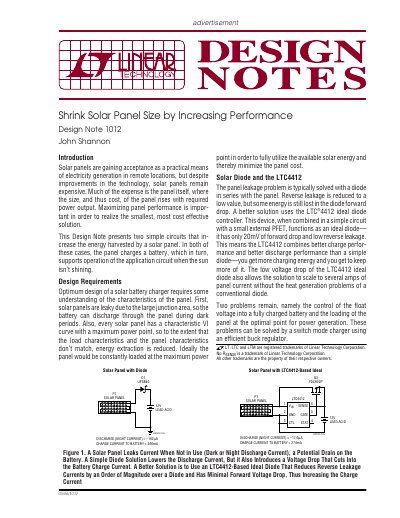
Solar panels are often expensive, so maximizing their performance is key to reducing system cost. This document presents two simple circuit solutions to increase energy harvested from a solar panel charging a battery. The first solution addresses the problem of panel leakage current during dark periods by replacing a standard diode with an LTC4412-based ideal diode controller. This reduces reverse leakage significantly while minimizing forward voltage drop, resulting in higher charge currents and lower discharge currents compared to traditional diodes.
The second solution involves using a switch-mode charger based on the LTC1625 synchronous buck controller combined with an LTC1541 control loop. This circuit regulates the battery float voltage and forces the solar panel to operate at its maximum power point, regardless of mismatches between the panel's characteristic curve and the load. The result is a more efficient system that can shrink the required solar panel size for a given application.
The LTC4412 reduces reverse leakage currents by an order of magnitude over a diode.
The circuit can provide as high as 22% extra current into a deeply discharged (10V) battery.
The device has only 20mV of forward drop.