
This document describes a dual output synchronous boost converter that solves thermal problems in harsh environments. By replacing the Schottky output rectifier with a synchronous MOSFET rectifier, power dissipation can be reduced, eliminating the need for heat sinks and reducing costs.
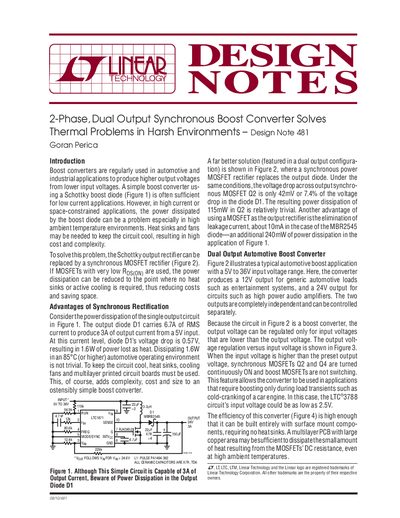
This document is a design note (Application Note) regarding the LTC3788, a dual output synchronous boost controller. It addresses thermal problems caused by power dissipation in Schottky diodes within high-current or high-temperature applications.
The text details how replacing the output rectifier with asynchronous MOSFETs reduces heat generation, eliminating the need for heat sinks and fans. It presents a specific automotive application circuit that generates 12V and 24V outputs from a 5V to 36V input range, achieving over 95% efficiency.
It solves thermal problems in harsh environments by replacing the Schottky output rectifier with an asynchronous MOSFET rectifier to reduce power dissipation and eliminate the need for heat sinks or active cooling.
The converter accepts a 5V to 36V input voltage range and produces independent 12V and 24V outputs.
When the input voltage exceeds the preset output voltage, synchronous MOSFETs are turned continuously ON and boost MOSFETs stop switching.