
This design note explains how to create a compact battery charger using a small 2-cell solar panel to provide renewable energy charging for battery-powered sensors and other devices located far from the power grid.
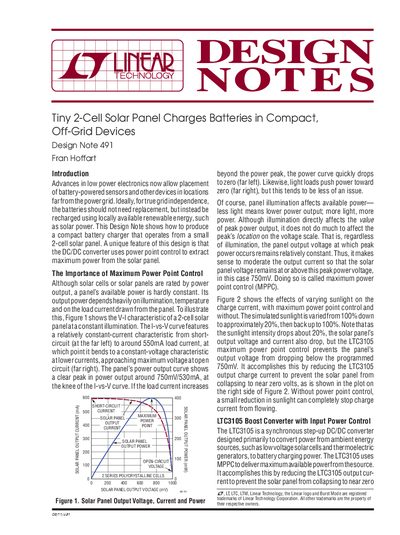
This document presents a design solution for charging batteries from a small 2-cell solar panel in off-grid devices. The core of the design utilizes the LTC3105 synchronous step-up DC/DC converter, which employs Maximum Power Point Control (MPPC) to extract maximum power from the solar source regardless of varying illumination or temperature conditions.
The circuit also incorporates an LTC4071 Li-Ion shunt charger to manage battery charging with precision float voltage and safety features. The design ensures that the solar panel voltage remains above its peak power point (approximately 750mV) by adjusting the output current, preventing the panel from collapsing under low-light conditions.
The converter can begin operation with an input as low as 250mV.
The system produces over 600mA of charge current under these conditions.