
This document is provided by ICminer.com Electronic-Library Service, copyright belongs to ICminer.com. The document describes the features and characteristics of ICminer.com Electronic-Library Service.
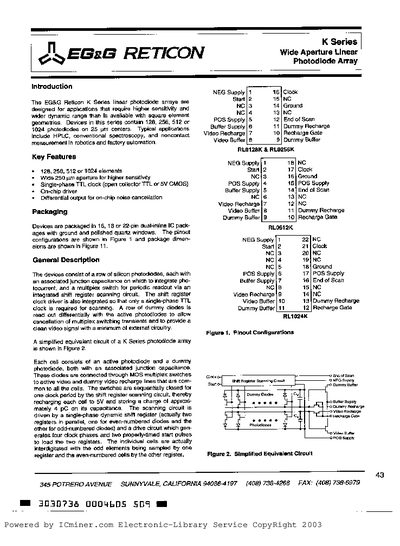
The EG&G K Series linear photodiode arrays are designed for high‑sensitivity, wide‑dynamic‑range applications such as HPLC, spectroscopy, and non‑contact measurement in robotics and factory automation. Available in 128, 256, 512, or 1024 element configurations, the devices use a single‑phase TTL clock and provide differential output for noise cancellation.
The document includes key features, packaging details, electrical and electro‑optical characteristics, drive requirements, and ordering information, along with evaluation board options for system integration.
| Clock frequency (fg) typical | 1 MHz |
|---|---|
| Diode aperture width | 250 nm |
The array needs two power supplies, nominally +5 V and –10 V.
Devices are available with 128, 256, 512, or 1024 elements.
The typical clock frequency is up to 1 MHz.