
The MCRF200 is a low-power radio frequency identification device that operates at 100 kHz-400 kHz. It can receive and send data through an external LC resonant circuit. The device has 128 bits of user programmable memory, which can be programmed by using a contactless programmer in a microID.
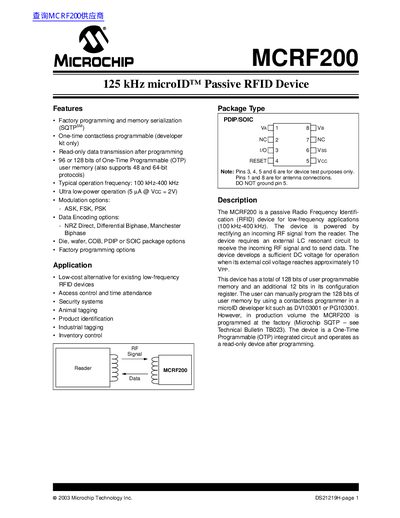
The MCRF200 microID™ passive RFID device is intended for low‑frequency RFID applications such as access control, animal tagging, inventory control and industrial tagging. It is powered by rectifying the RF field from a reader and requires an external LC resonant circuit.
Key features include factory programming, selectable memory size (96 or 128 bits OTP), multiple modulation schemes (ASK, FSK, PSK), various data‑encoding options, and ultra‑low power consumption (5 µA at 2 V). The device is offered in die, wafer, COB, PDIP or SOIC packages and can be programmed at the factory or via a developer kit.
| Operating frequency range | 100 kHz‑400 kHz |
|---|---|
| User memory size | 96 or 128 bits OTP (up to 128 bits) |
| Modulation options | ASK, FSK, PSK |
| Operating current | 5 µA @ VCC = 2 V |
| Turn‑on voltage | 10 VPP |
| Input capacitance | 2 pF |
The device operates between 100 kHz and 400 kHz.
It offers either 96 bits or 128 bits of one‑time programmable user memory.
The MCRF200 supports ASK, FSK and PSK modulation.
It consumes about 5 µA when powered at 2 V.