
NPN silicon RF twin transistor features low voltage operation, low phase distortion, and low noise.
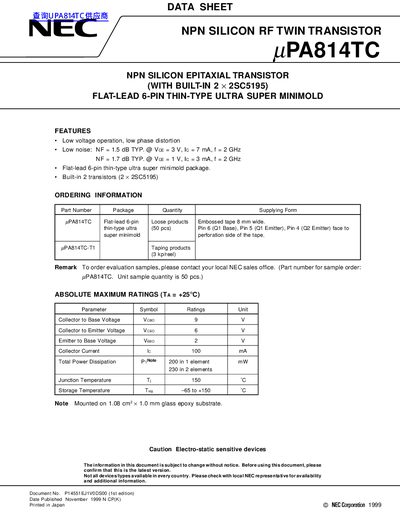
The uPA814TC is an NPN silicon RF twin transistor offered in a flat‑lead 6‑pin ultra‑super minimold package. It features low‑voltage operation, low phase distortion, low noise (NF = 1.5 dB typical at VCE = 3 V, IC = 7 mA) and includes two built‑in transistors (2 × 2SC5195). Ordering information, part numbers and sample request details are also listed.
Electrical characteristics are presented for a range of bias conditions, including collector‑to‑base voltage, collector‑to‑emitter voltage, collector current limits, noise figure, gain‑bandwidth product and S‑parameters. Absolute maximum ratings and typical performance curves are provided to aid design and verification.
| Collector to Base Voltage (VSO) | 9 V |
|---|---|
| Collector to Emitter Voltage (VOCE) | 6 V |
| Emitter to Base Voltage (VEB) | 2 V |
| Maximum Collector Current (IC) | 100 mA |
| Total Power Dissipation | 200 mW (1 element) |
| Built‑in Transistors | 2 (2 × 2SC5195) |
| Package | Flat‑lead 6‑pin thin‑type ultra super minimold |
The maximum collector current is 100 mA.
The device contains two built‑in transistors (2 × 2SC5195).
The typical noise figure is 1.5 dB.
It uses a flat‑lead 6‑pin thin‑type ultra super minimold package.