
The AD9748 is an 8-bit resolution, 210 MSPS TxDAC® D/A converter. It features high performance, excellent linearity, and a CMOS-compatible digital interface. It is suitable for applications in communications, direct digital synthesis (DSS), and instrumentation.
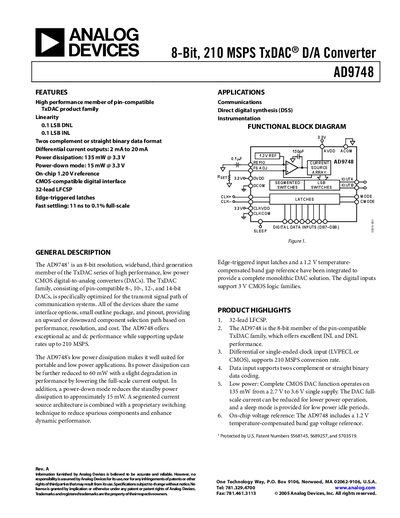
The AD9748 is an 8‑bit, high‑speed TxDAC® converter optimized for transmit signal paths in communication systems. It offers 0.1 LSB INL and DNL, differential current outputs of 2 mA to 20 mA, and a low typical power dissipation of 135 mW.
Key specifications include a 210 MSPS maximum update rate, 11 ns settling time, and a supply voltage range of 2.7‑3.6 V. The device features an on‑chip 1.2 V reference, CMOS‑compatible digital interface, and a 32‑lead LFCSP package.
| Resolution | 8 Bits |
|---|---|
| Full‑Scale Output Current | 2 mA – 20 mA |
| Power Dissipation (typical) | 135 mW |
| Supply Voltage (AVDD) | 2.7 V – 3.6 V |
| Output Settling Time (0.1 % FS) | 11 ns |
| Maximum Output Update Rate | 210 MSPS |
The AD9748 can update its output at up to 210 MSPS.
Typical power dissipation is 135 mW.
The analog supply voltage (AVDD) ranges from 2.7 V to 3.6 V.
The device provides an 8‑bit resolution.