
The Fluke 1AC II VoltAlert is a voltage detector from Fluke. It is very easy to use - just touch the tip to a terminal strip, outlet or cord. When the tip glows red and the unit beeps, you know there is voltage on the line.
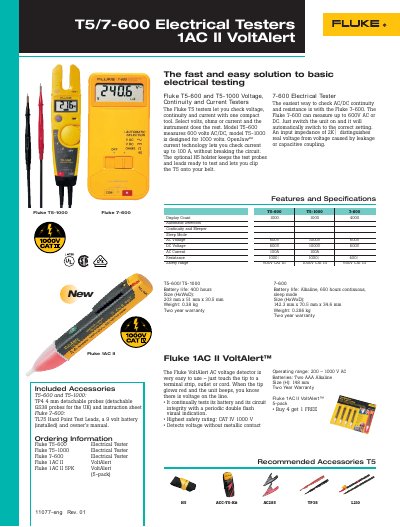
The Fluke 1AC II VoltAlert™ is an AC voltage detector that signals the presence of voltage by a red glowing tip and an audible beep. It continuously checks its battery and circuit integrity with a double‑flash visual indicator and carries a CAT IV 1000 V safety rating.
The sheet also provides key specifications for the VoltAlert and related Fluke testers, including operating voltage range (200‑1000 V AC), battery type (two AAA alkaline), size (148 mm height), input impedance (2 kΩ), and battery life (400 h for T5‑600/1000, 650 h for 7‑600). Included accessories and ordering information are summarized at the end.
| Operating range | 200 – 1000 V AC |
|---|---|
| Safety rating | CAT IV 1000 V |
| Battery type | Two AAA Alkaline |
| Height | 148 mm |
| Battery life (T5‑600/1000) | 400 hours |
| Battery life (7‑600) | 650 hours |
| Input impedance | 2 kΩ |
| Current measurement capability | Up to 100 A |
It has a CAT IV 1000 V safety rating.
The tip glows red and the unit beeps when voltage is detected.
It uses two AAA alkaline batteries.
It operates from 200 V to 1000 V AC.