
This is an instruction manual for KENWOOD TM-271A and TM-271E transceivers, which provides details on how to use them.
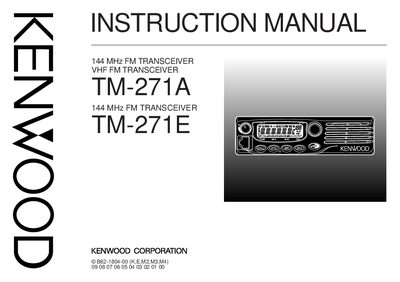
This manual introduces the Kenwood TM-271A and TM-271E VHF FM transceivers, covering safety precautions, mobile installation, and basic operation. It describes key features such as up to 200 memory channels, a weather‑alert function, and a dedicated data connector for packet operation.
The guide is organized into chapters on preparation, mobile installation, DC power and antenna connections, accessory connections, menu setup, memory channel programming, scanning, DTMF functions, auxiliary functions, troubleshooting, and a specifications section.
| Operating frequency | 144 MHz FM |
|---|---|
| Power source voltage | 13.8 V |
| Memory channels | Up to 200 (up to 100 with channel names) |
| Weather Alert tone | 1050 Hz |
| Data connector speed | 1200 bps / 9600 bps |
The transceiver is designed for a 13.8 V power source.
The unit can store up to 200 memory channels, or up to 100 if channel names are assigned.
It checks the 1050 Hz tone from NOAA weather alerts.
K indicates the Americas market, while E indicates the European market.