
The TSL2560 and TSL2561 are light-to-digital converters that transform light intensity to a digital signal output capable of direct I2C (TSL2561) or SMBus (TSL2560) interface. Each device combines one broadband photodiode (visible plus infrared) and one infrared-responding photodiode on a single CMOS integrated circuit capable of providing a near-photopic response over an effective 20-bit dynamic range (16-bit resolution). Two integrating ADCs convert the photodiode currents to a digital output that represents the irradiance measured on each channel. This digital output can be input to a microprocessor where illuminance (ambient light level) in lux is derived using an empirical formula.
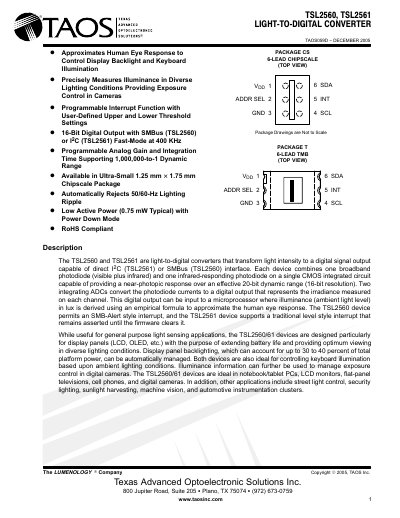
The TSL2560 and TSL2561 are second‑generation ambient light sensors that combine a broadband photodiode and an infrared‑only photodiode on a single CMOS chip. They provide a near‑photopic response and a 16‑bit digital output, supporting programmable gain, integration time, and interrupt thresholds for a wide range of lighting conditions.
The devices are offered in ultra‑small 1.25 mm × 1.75 mm chip‑scale and TMB packages, operate from 2.7 V to 3.8 V, and draw as little as 3.2 µA in power‑down mode. Detailed electrical, mechanical, and manufacturing specifications are provided for designers integrating the sensors into displays, keyboards, cameras, and other illumination‑sensitive applications.
| Package size | 1.25 mm × 1.75 mm |
|---|---|
| Digital output resolution | 16‑bit |
| Supply voltage range | 2.7 V to 3.8 V |
| Active supply current | 0.24 mA to 0.6 mA |
| Power‑down current | 3.215 µA |
| Operating temperature range | -30 °C to 70 °C |
| Photodiodes per device | Two (broadband and IR‑only) |
The TSL2560 uses the SMBus interface, compatible with I2C Fast‑Mode at 400 kHz.
The active supply current ranges from 0.24 mA to 0.6 mA.
Each device contains two photodiodes: one broadband and one infrared‑only.