
The ADL5350 is a high linearity, up-and-down converting mixer capable of operating over a broad input frequency range. It is well suited for demanding cellular base station mixer designs that require high sensitivity and effective suppression of second-order harmonics.
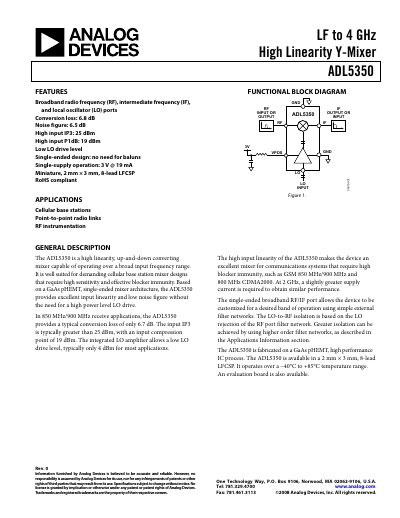
The ADL5350 is a broadband up‑and‑down converting mixer built on a GaAs pHEMT process. It offers low conversion loss, low noise figure, and high input linearity, making it suitable for cellular base‑station and point‑to‑point radio applications. The device operates from –40 °C to +85 °C and requires a single 3 V supply.
The datasheet provides detailed specifications, absolute maximum ratings, pin descriptions, typical performance curves, and an optional evaluation board with two frequency‑band configurations. Ordering information and package dimensions are also included.
| RF Frequency Range | 750‑975 MHz |
|---|---|
| LO Frequency Range | 500‑945 MHz |
| Conversion Loss (typical at 850 MHz) | 6.7 dB |
| Noise Figure (typical at 850 MHz) | 6.4 dB |
| Input Third‑Order Intercept (IP3) | 25 dBm |
| Input 1 dB Compression Point (P1dB) | 19.8 dBm |
| Supply Voltage | 2.7‑3.5 V |
| Supply Current (typical at 3 V) | 16.5 mA |
| Operating Temperature Range | −40 °C to +85 °C |
The typical conversion loss at 850 MHz is about 6.7 dB.
The device is specified for a 3 V supply, with a rating range of 2.7 V to 3.5 V.
The mixer operates with a low LO drive level, typically 4 dBm (6 dBm for the 1950 MHz version).
It operates from –40 °C up to +85 °C.