
ST series power sensors are complete miniature power meters. The sensors contain a CPU that controls the sensor, processes the measurement results and operates the interface. All measurement data and settings can be transmitted via a USB interface to and from a PC. This gives the concept of using a PC as the user interface in classic microwave power measurement. Connecting a sensor directly to a PC is the most cost-effective method for high-precision power measurements, especially if a PC is used already for data acquisition and evaluation. This is commonly the case in production environments that include a process controller. Omitting the display unit saves space in the rack and reduces costs. The ST Series has the ability have multiple sensor heads connected to the PC and operated simultaneously. An added advantage to the production user Service technicians too will also appreciate this product since the power sensor is only 1.9 x 1.2 x 6.7 inches 34x 43 x 125mm and can easily be operated from a laptop. Satori currently plan to use the ST Series with a PDA as a controller to improve usability for the I&M Market. The Power Meter is controlled using the Satori software loaded
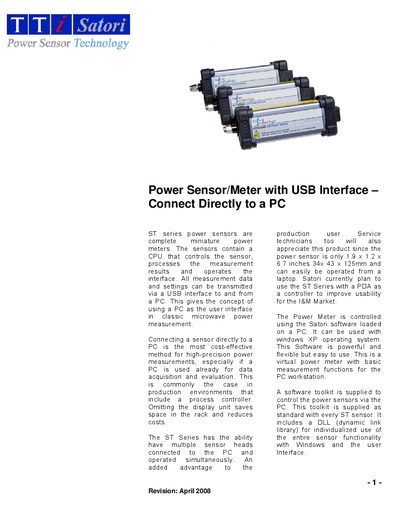
The Satori ST Series are miniature power sensors that operate as virtual power meters when connected to a PC via USB. The sensors contain an integrated CPU that processes measurement data and provides a USB interface for data transfer, allowing a PC to serve as the user interface.
The series includes several models (ST124SMA, ST185SMA, ST265SMA) with frequency coverage from 10 MHz up to 26.5 GHz, measurement ranges of –50 dBm to +20 dBm, and compact dimensions (34 × 43 × 125 mm, 83 g). All models use SMA or K‑type connectors and USB 2.0 connectivity with a typical power draw of about 50 mA.
| Frequency range (ST124SMA) | 10 MHz – 12.4 GHz |
|---|---|
| Frequency range (ST185SMA) | 10 MHz – 18.5 GHz |
| Frequency range (ST265SMA) | 10 MHz – 26.5 GHz |
| Measurement range | –50 dBm to +20 dBm CW |
| Operating temperature | up to 50 °C |
| Connector type (ST124SMA / ST185SMA) | SMA (male) |
| Connector type (ST265SMA) | K‑type (male) |
| USB connectivity | USB 2.0, cable up to 5 m |
| USB power draw | ≈ 50 mA |
| Dimensions (max) | 34 mm H × 43 mm W × 125 mm L |
| Weight | 83 g |
| Maximum input power (damage level) | 200 mW CW (+23 dBm) |
| Input SWR (max) | 1.2:1 (ST124/185), 1.25:1‑1.35:1 (ST265) |
| Noise floor | 0.15 nW RMS (ST124/185), 0.14 nW (ST265) |
The ST124SMA sensor operates from 10 MHz up to 12.4 GHz.
The ST265SMA sensor uses a K‑type male connector.
Each sensor draws approximately 50 mA from the USB 2.0 connection.
All three models can tolerate up to 200 mW continuous wave (+23 dBm) before damage.