
The LT1920 is a single resistor gain programmable, precision instrumentation amplifier that requires only one external resistor to set gains of 1 to 10,000. It offers low power dissipation, low voltage noise, high accuracy, and various other features making it a cost-effective solution for precision instrumentation amplifier applications.
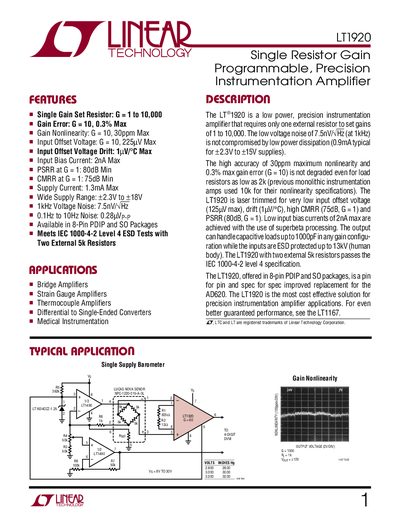
The LT1920 is a precision instrumentation amplifier that requires only one external resistor to set gains from 1 to 10 000. It offers low voltage noise (7.5 nV/√Hz at 1 kHz), low input bias current (2 nA max), and high CMRR and PSRR (75 dB and 80 dB at G=1). The device is available in 8‑lead PDIP and SO packages and meets IEC 1000‑4‑2 Level 4 ESD tests.
Typical applications include bridge amplifiers, strain‑gauge and thermocouple amplifiers, differential‑to‑single‑ended converters, and medical instrumentation. Detailed electrical characteristics, absolute maximum ratings, and typical performance graphs are provided.
| Gain Error (G=10) | 0.3 % max |
|---|---|
| Input Offset Voltage (G=10) | 225 µV max |
| Input Bias Current | 2 nA max |
| Supply Current | 1.3 mA max |
| CMRR (G=1) | 75 dB min |
| PSRR (G=1) | 80 dB min |
| Supply Voltage Range | +2.3 V to +18 V |
| Bandwidth (G=1) | 1000 kHz |
| Noise Voltage (0.1 Hz‑10 Hz) | 0.28 µV p‑p |
The device operates from a wide supply range of +2.3 V to +18 V.
At a gain of 10 the input offset voltage is limited to 225 µV maximum.
Typical applications include bridge amplifiers, strain‑gauge amplifiers, thermocouple amplifiers, differential‑to‑single‑ended converters, and medical instrumentation.