
This file is a brief description of the 713 series sensor connectors, including the types, functions, features and protection levels of the connectors.
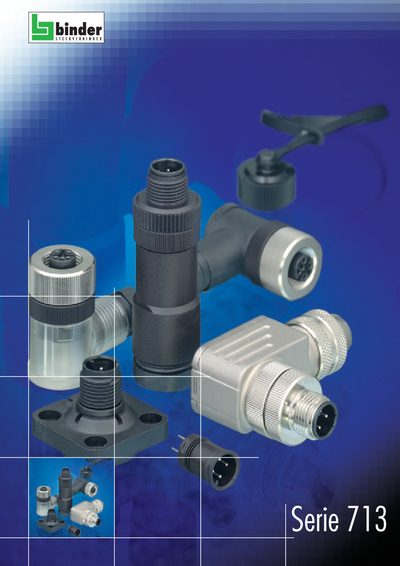
The Binder Series 713 sensor connectors (M12×1) are offered in various configurations such as male cable connectors, angled connectors, duo connectors and female sockets. They are available in shielded and unshielded versions, with plastic or metal locking systems, and can be equipped with LED inserts.
Key technical data include an IP67 protection rating, operation temperature range from –40 °C to +85 °C, rated voltage of 250 V, impulse voltage of 2500 V, contact resistance as low as 3 mΩ (gold plated), insulation resistance of 210 MΩ, and a mechanical life of more than 50 mating cycles. The connectors support up to 5 contacts and are compatible with series 763 components. This manual is written in German.
| Protection rating (IP) | IP67 |
|---|---|
| Mechanical life | > 50 mating cycles |
| Upper temperature limit | +85 °C |
| Lower temperature limit | –40 °C |
| Rated voltage | 250 V |
| Rated impulse voltage | 2500 V |
| Insulation resistance | 210 MΩ |
The connectors have an IP67 protection rating.
The upper temperature limit is +85 °C.
They are rated for more than 50 mating cycles.