
The ISL9200 is an integrated circuit (IC) optimized to provide a Li-ion battery redundant safety protection from failures of a charging system.
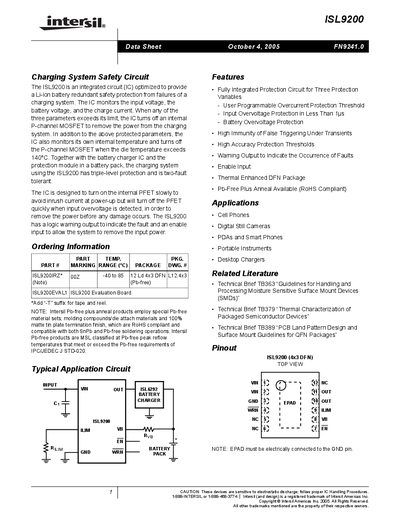
The ISL9200 is an integrated circuit that provides redundant safety protection for Li‑ion battery charging systems. It monitors input voltage, battery voltage, charge current and its own die temperature, turning off an internal P‑channel MOSFET when any limit is exceeded.
The device includes programmable over‑current protection, input and battery over‑voltage protection, a warning output (WRN) and an enable input (EN). It is supplied in a thermally enhanced 4×3 DFN package and is RoHS‑compliant.
| Input Overvoltage Protection threshold | 6.8 V (typical) |
|---|---|
| Battery Overvoltage Protection threshold | 4.4 V ±75 mV hysteresis |
| Over‑temperature shutdown threshold | 140 °C |
| WRN output behavior | Open‑drain, goes LOW on fault |
It uses the WRN pin, an open‑drain output that goes low when any protection event occurs.
The device disables the PFET when its internal temperature reaches 140 °C.
Driving EN low (below 0.4 V) or leaving it floating enables the IC; pulling it high disables it.