
The LT6300 is a 500mA minimum output current, dual op amp with outstanding distortion performance. Amplifiers are gain-of-ten stable, but can be easily compensated for lower gains. Extended output swing allows for lower supply rails to reduce system power. Supply current is set with an external resistor to optimize power dissipation. The LT6300 features balanced, high impedance inputs with low input bias current and input offset voltage. Active termination is easily implemented for further system power reduction. Short-circuit protection and thermal shutdown insure the device’s ruggedness. The outputs drive a 100Ω load to ±10.9V with ±12V supplies, and ±10.7V with a 250mA load. The LT6300 is a functional replacement for the LT1739 and LT1794 in xDSL line driver applications and requires no circuit changes. The LT6300 is available in the very small, thermally enhanced, 16-lead SSOP package (same PCB area as the SO-8 package).
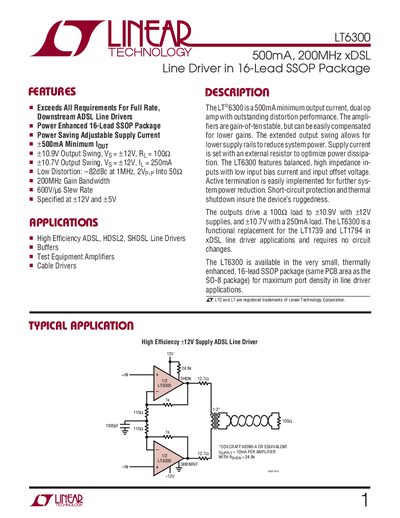
The LT6300 is a dual voltage‑feedback amplifier designed for xDSL line‑driver applications. It delivers a minimum 500 mA output current, up to +10.9 V swing, and features low distortion (‑82 dBc at 1 MHz) with a 200 MHz gain‑bandwidth. The device is offered in a compact 16‑lead SSOP package for high‑density PCB layouts.
Key features include adjustable quiescent current via the SHDN/SHDNREF pins, short‑circuit protection, thermal shutdown, and configurable output swing. Typical applications are high‑efficiency ADSL, HDSL2, and SHDSL line drivers where power consumption and performance are critical.
| Minimum Output Current | 500 mA |
|---|---|
| Gain Bandwidth | 200 MHz |
| Output Swing (V‑) | +10.7 V |
| Slew Rate | 600 V/µs |
| Supply Voltage | +12 V (operating), +5 V shutdown |
| Operating Temperature Range | -40 °C to 85 °C |
| Package | 16‑Lead Plastic SSOP |
The LT6300 can source or sink up to 500 mA per amplifier.
It operates from a +12 V supply and includes a +5 V shutdown mode.
The device is specified to operate from –40 °C to +85 °C.
Quiescent current is set via the SHDN and SHDNREF pins, using external resistors such as Rpjas or Rejas.