
The document describes an LED flash driver with an I2C-compatible interface, featuring small size, high efficiency, and programmable current.
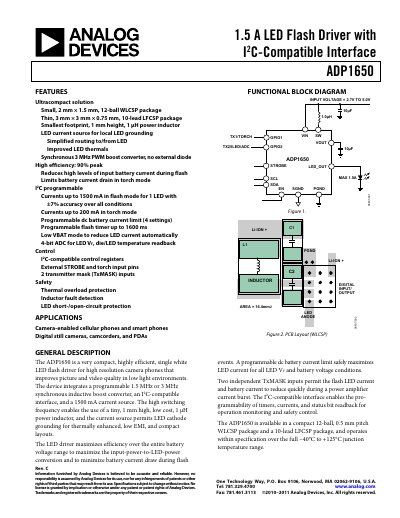
The ADP1650 LED flash driver integrates a programmable 1.5 MHz or 3 MHz synchronous boost converter, a 1500 mA LED current source, and an I²C‑compatible interface. It is offered in a 12‑ball WLCSP package (2 mm × 1.5 mm) and a 10‑lead LFCSP package (3 mm × 3 mm × 0.75 mm) and operates from 2.7 V to 5.0 V across –40 °C to +125 °C.
The datasheet provides detailed specifications, pin descriptions, thermal data, safety features, and typical performance curves to aid designers in integrating the driver into camera‑enabled mobile devices, digital cameras, and PDAs.
| Input Voltage Range | 2.7 V – 5.0 V |
|---|---|
| Maximum LED Current (Flash Mode) | 1500 mA |
| Switching Frequency | 3 MHz (or 1.5 MHz) |
The device operates from 2.7 V to 5.0 V supply voltage.
It can source up to 1500 mA of LED current in flash mode.
The driver can run at either 1.5 MHz or 3 MHz synchronous boost frequency.