
AD9789 is a flexible QAM encoder/interpolator/upconverter combining high performance with low power consumption, and it is designed for DOCSIS 3.0 and other broadband applications.
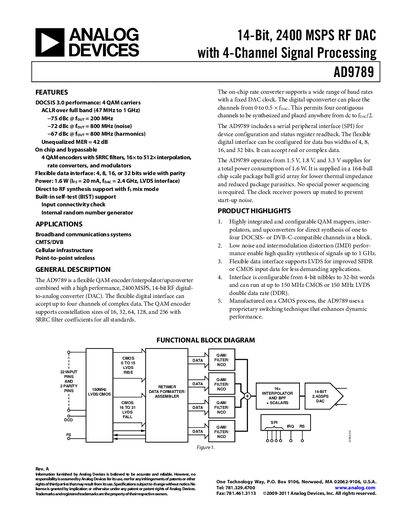
The AD9789 is a highly integrated 14‑bit, 2400 MSPS RF digital‑to‑analog converter that combines a QAM encoder, interpolator, and upconverter in a single chip. It supports flexible data interfaces (4‑ to 32‑bit CMOS or LVDS) and includes built‑in self‑test features, making it suitable for direct synthesis of up to four DOCSIS‑ or DVB‑C‑compatible channels.
Typical applications include broadband communications systems, CMTS/DVB, cellular infrastructure, and point‑to‑point wireless links. The device operates from 1.5 V, 1.8 V, or 3.3 V supplies, consumes 1.6 W, and is supplied in a 164‑ball CSP‑BGA package for low thermal impedance.
| DAC Resolution | 14 Bits |
|---|---|
| Full‑Scale Output Current (typical) | 20.2 mA |
| Output Resistance | 70 Ω |
| Analog Supply Voltage (AVDD33) typical | 3.3 V |
| Power Dissipation (CMOS Interface) | 1.7 W |
The CMOS data interface can operate up to 150 MHz.
The AD9789 operates from 1.5 V, 1.8 V, and 3.3 V analog and digital supplies.
The device supports four QAM carriers for DOCSIS 3.0.