
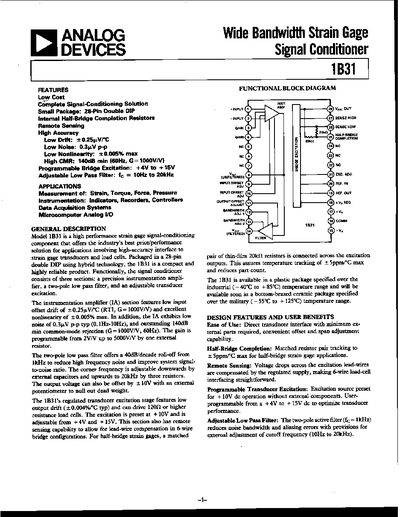
The 1B31 is a compact 28‑pin double‑DIP signal‑conditioning component for strain‑gage, torque, force and pressure transducers. It integrates a precision instrumentation amplifier, a programmable low‑pass filter and an adjustable bridge‑excitation stage, offering low noise, low drift and high common‑mode rejection.
The manual provides full specifications, pin assignments, wiring diagrams, and step‑by‑step operating instructions, plus application examples such as single‑gage strain measurement, pressure‑transducer interfacing, multiple load‑cell systems and mobile‑transducer setups.
| Gain Range | 20 – 5000 V/V |
|---|---|
| Nonlinearity | +0.005 % max |
| Common‑Mode Rejection (CMR) | ≥ 140 dB at 60 Hz |
| Input Noise (0.1‑10 Hz) | 0.3 pV p‑p |
| Adjustable Low‑Pass Filter Cutoff | 10 Hz – 20 kHz |
| Bridge Excitation Voltage | +4 V – +15 V (preset +10 V) |
The gain can be programmed from 20 to 5000 V/V.
The cutoff frequency is adjustable from 10 Hz to 20 kHz using external capacitors and resistors.
It provides a minimum CMR of 140 dB at 60 Hz.
The input noise is typically 0.3 pV peak‑to‑peak.