
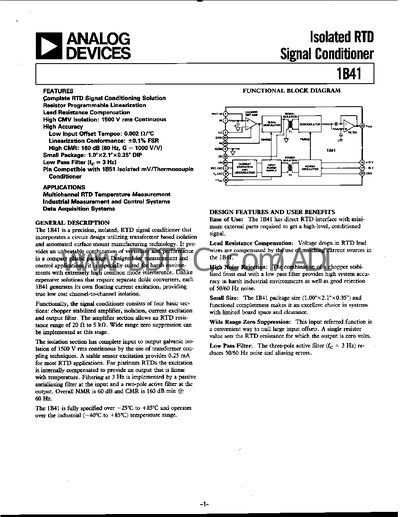
The 1B41 provides a complete RTD signal‑conditioning solution featuring resistor‑programmable linearization, lead‑resistance compensation, and high common‑mode voltage isolation of 1500 V rms. Its small 1.0" × 2.1" × 0.35" DIP package makes it suitable for space‑constrained designs, while a three‑pole active low‑pass filter (3 Hz) reduces 50/60 Hz noise.
The device operates from a +13.5 V to +18 V supply, supplies a 0.25 mA excitation current for Pt‑100 RTDs, and delivers gain accuracy of 2 % FSR. It is specified for an industrial temperature range (‑40 °C to +85 °C) and offers 160 dB CMR at 60 Hz. Pin assignments and functional block diagrams are provided for easy integration.
| Maximum CMV Isolation (continuous) | 1500 V rms |
|---|---|
| Common‑Mode Rejection (CMR) at 60 Hz | 160 dB min |
| Low‑Pass Filter Cutoff Frequency | 3 Hz |
| Sensor Current Excitation | 0.25 mA |
| Power Supply Operating Voltage | +13.5 V to +18 V |
| Gain Accuracy | 2 % FSR (5 % FSR max) |
The 1B41 can handle up to 1500 V rms continuous common‑mode voltage.
The low‑pass filter is set to a cutoff frequency of 3 Hz.
It provides a sensor excitation current of 0.25 mA.
The gain accuracy is 2 % of full‑scale range, with a maximum of 5 % FSR.