
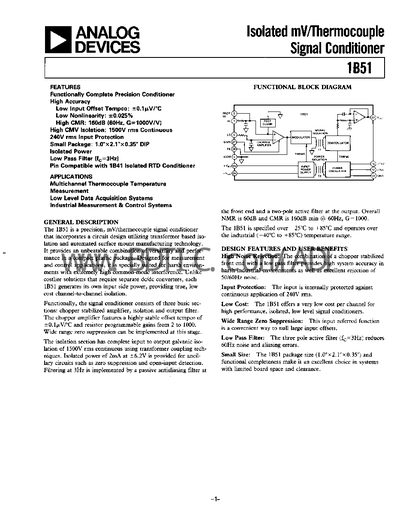
The 1B51 is a precision isolated mV/thermocouple signal conditioner that provides high accuracy, low input offset (±0.1 pV/°C), and excellent common‑mode rejection (160 dB). It integrates transformer‑based isolation, a chopper‑stabilized amplifier, and a low‑pass filter in a compact 1.0" × 2.1" × 0.35" DIP package, making it suitable for multichannel temperature measurement and low‑level data‑acquisition systems.
The handbook includes functional block diagrams, detailed specifications, and application notes such as gain setting, zero‑suppression, open‑input detection, and cold‑junction compensation. It also describes the isolated power supply (2 mA at +6.2 V) and input protection against 240 V rms, supporting operation over an industrial temperature range of –40 °C to +85 °C.
| Low Input Offset Tempco | +0.1 pV/°C |
|---|---|
| Low Nonlinearity | +0.025 % |
| Common‑Mode Rejection (CMR) | 160 dB (60 Hz, G=1000 V/V) |
| Common‑Mode Voltage Isolation | 1500 V rms continuous |
| Input Voltage Range (Linear Differential) | 10 mV to +5 V |
| Isolated Power Output | 2 mA at +6.2 V |
| Operating Temperature Range | -40 °C to +85 °C |
| Package Size | 1.0" × 2.1" × 0.35" (25.4 mm × 53.3 mm × 8.9 mm) |
The 1B51 provides a common‑mode voltage isolation of 1500 V rms continuous.
Zero‑suppression is implemented by applying a reference voltage to the LO terminal so that the differential input voltage multiplied by the gain results in zero output.
The input is internally protected against continuous application of 240 V rms.
It supplies isolated power of 2 mA at +6.2 V for auxiliary functions such as zero suppression and open‑input detection.