
TES-32 Battery Capacity Tester can measure the internal resistance and open circuit voltage of lead-acid batteries, nickel-cadmium batteries, lithium batteries and nickel-hydrogen batteries.
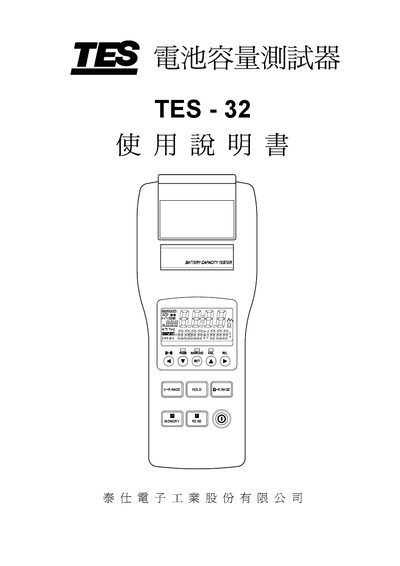
The TES-32 battery capacity tester measures internal resistance and open‑circuit voltage of rechargeable batteries such as lead‑acid, Ni‑Cd, Li‑ion and Ni‑MH. It uses an AC four‑terminal method for high‑accuracy resistance measurement and provides dual LCD and LED displays for simultaneous resistance and voltage readout. Up to 99 comparator sets can be stored to monitor battery aging.
The guide covers preparation, step‑by‑step usage, zero‑adjustment, comparator configuration, data‑recording (manual up to 999 entries, continuous up to 6000), and maintenance procedures including battery replacement and cleaning. Safety warnings and environmental limits are also provided. This manual is written in Chinese.
| Measurement method | AC four‑terminal method |
|---|---|
| Display | Dual LCD and LED indicators |
| Sample rate | 1 set per second |
| Maximum open‑circuit voltage | ≈5.8 V |
| Comparator groups | 99 |
| Manual data records capacity | 999 entries |
| Continuous data records capacity | 6000 entries |
| Operating temperature range | 0 °C to +40 °C, <80 % RH |
| Power source | Six 1.5 V AA batteries (optional 9 V AC adapter) |
| Continuous operation time | ≈7 hours |
| Dimensions | 250 mm × 100 mm × 45 mm |
| Weight | ≈500 g (including batteries) |
Short the red and black test leads, press the REL key; the display shows an “R” symbol and the resistance and voltage values reset to zero.
The device can store up to 99 comparator groups.
Up to 999 manual data records can be stored in memory.
It is powered by six AA (1.5 V) batteries, with an optional 9 V AC adapter available.