
This document introduces the high-performance master-slave PCI interface card, which supports multiple protocols such as Profibus, DeviceNet, AS-Interface, and industrial Ethernet. The interface card is based on the mature Anybus technology, with powerful functionality and interchangeability. Additionally, the interface card also provides a free OPC server for accessing real-time data.
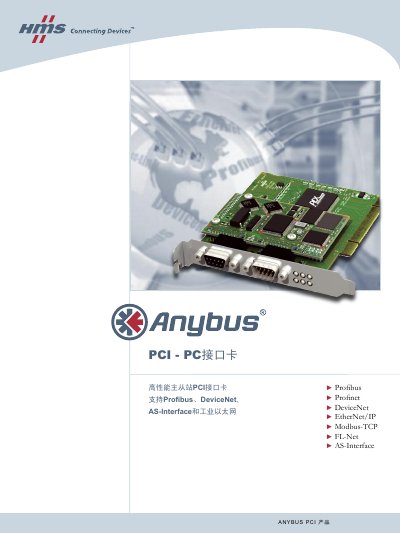
The HMS ANYBUS-PCI is a high‑performance master/slave PCI interface card that supports Profibus, DeviceNet, AS‑Interface and several industrial Ethernet protocols such as Profinet, EtherNet/IP, Modbus‑TCP and FL‑Net. It includes a built‑in microprocessor, dual‑port RAM and a standardized API, allowing plug‑and‑play compatibility across all Anybus products.
The card operates on 3.3 V or 5 V power supplies, provides a free OPC server, and comes with the Anybus NetTool configuration software for easy setup of fieldbus and Ethernet networks. Technical specifications, dimensions, certifications and environmental limits are detailed in the manual. This manual is written in Chinese.
| Power supply | 3.3 V & 5 V, 600 mA |
|---|---|
| PCI bus clock | 33 MHz |
| Dimensions | 100 × 120 × 22 mm |
| Operating temperature | 0 °C to +55 °C |
| Digital inputs | 248 |
| Digital outputs | 186 |
| Analog inputs | 124 (16‑bit) |
| Free OPC server | Included |
The card is configured with the Anybus NetTool configuration tool.
Yes, a free OPC server is provided with the card.
It supports both 3.3 V and 5 V power supplies, up to 600 mA.
The card measures 100 × 120 × 22 mm (width × length × height).