
Starvert iG5A is a low-voltage inverter launched by LG. This inverter has sensorless vector control function, which realizes excellent speed control and powerful torque function. It also has run-time leakage protection function, cooling fan control function, built-in communication function, built-in PID control and other functions.
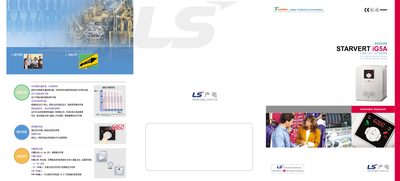
The LS STARVERT iG5A is an intelligent variable frequency drive offering sensor‑less vector control, high‑speed response and built‑in communication interfaces. It supports three‑phase input voltages of 200‑230 V or 380‑460 V and provides automatic carrier‑frequency adjustment based on temperature.
The manual describes the input/output terminals, analog and digital I/O ranges, cooling‑fan control, leakage‑protection, and various operating modes such as digital and analog set‑points. It also outlines protection functions, physical structure, and recommended installation practices. This manual is written in Chinese.
| Power rating | 5.5–7.5 kW |
|---|---|
| Input voltage | 3‑phase 200‑230 V (+10%/‑15%) or 380‑460 V (+10%/‑15%) |
| Input frequency range | 0–400 Hz |
| Maximum carrier frequency | ≥3 kHz |
| Maximum frequency (sensor‑less vector control) | 300 Hz |
| Analog input range | -10 V to +10 V |
| Digital input type | PNP / NPN |
It accepts three‑phase 200‑230 V or 380‑460 V input, each with a tolerance of +10% / –15%.
Yes, the drive includes a sensor‑less vector control function for high‑speed and torque performance.
The analog input can be set between –10 V and +10 V.
Yes, the drive includes an output‑side leakage protection function during operation.