
This kit is used for quantitative measurement of Apo-A1 in rat serum, plasma, cell culture supernatant or other relevant biological fluids.
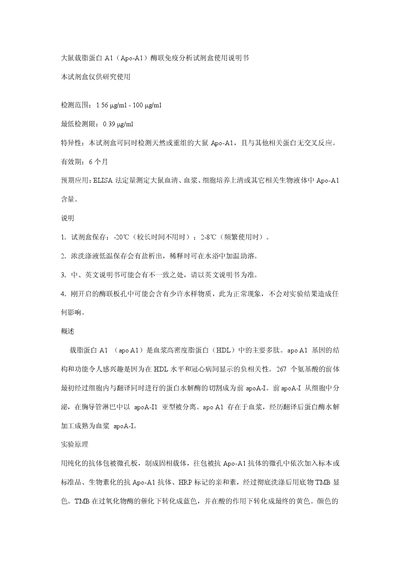
This manual describes the rat Apo‑A1 ELISA immunoassay kit, intended for quantitative measurement of Apo‑A1 in serum, plasma, cell culture supernatants and other biological fluids. It provides details on kit components, storage conditions, sample collection, and preparation of standards and reagents.
The document outlines the complete assay workflow: plate coating, sample and standard addition, incubation with biotin‑labeled antibody and HRP‑avidin, substrate development, and absorbance reading at 450 nm. It also includes guidelines for washing, plate handling, calculation of concentrations, and troubleshooting tips to ensure reliable results. This manual is written in Chinese.
| Detection range | 1.56 µg/ml – 100 µg/ml |
|---|---|
| Minimum detection limit | 0.39 ng/ml |
| Specificity | Detects natural or recombinant rat Apo‑A1 without cross‑reaction to related proteins |
| Shelf life | 6 months |
| Storage temperature | -20 °C for long‑term; 2‑8 °C for short‑term use |
The assay can measure Apo‑A1 concentrations from 1.56 µg/ml up to 100 µg/ml.
The lowest detectable concentration is 0.39 ng/ml.
Store the kit at –20 °C for long‑term storage, or at 2‑8 °C for short‑term use.
The kit is intended for rat serum, plasma, cell‑culture supernatants, and other related biological fluids.