
This document provides instructions for using the Rat Testosterone Enzyme-Linked Immunosorbent Assay (ELISA) Kit offered by USCN Life Science Inc., including expected applications, storage and expiration of the kit, provided reagents, experimental principles, and specimen collection and storage.
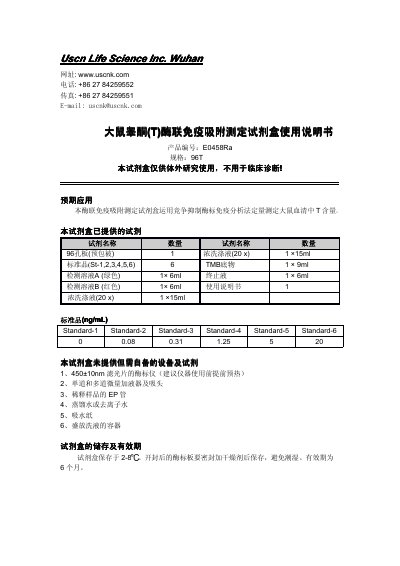
This kit uses a competitive inhibition ELISA to quantitatively determine testosterone levels in rat serum. The assay relies on competition between the sample testosterone and a labeled antigen for binding to a specific antibody coated on a 96‑well plate. After incubation and washing, the substrate TM B produces a color change inversely proportional to the testosterone concentration, which is measured at 450 nm.
The manual lists all reagents (96‑well plate, wash buffer, standards, TM B substrate, detection solutions A and B, stop solution) and required equipment (plate reader with 450 ± 10 nm filter, pipettes, EP tubes, distilled water, absorbent paper). It provides detailed steps for sample preparation, reagent preparation, plate loading, incubation, washing, color development, termination, and data analysis, along with storage conditions, shelf life, and safety warnings. This manual is written in Chinese.
| Detection range | 0.08 – 20 ng/mL |
|---|---|
| Limit of detection | 0.03 ng/mL |
| Shelf life | 6 months |
| Storage temperature | 2 – 8 °C |
| Plate type | 96‑well plate |
| Required plate reader wavelength | 450 ± 10 nm |
The assay can detect testosterone concentrations from 0.08 to 20 ng/mL.
Dilute the concentrate with 285 mL of distilled water to make 300 mL of 20‑fold wash buffer, and prepare standards at 20, 5, 1.25, 0.31, 0.08, and 0 ng/mL.