
This kit is used to quantitatively determine LEP content in rat serum, plasma, tissue homogenate, cell culture supernatant and other biological fluids.
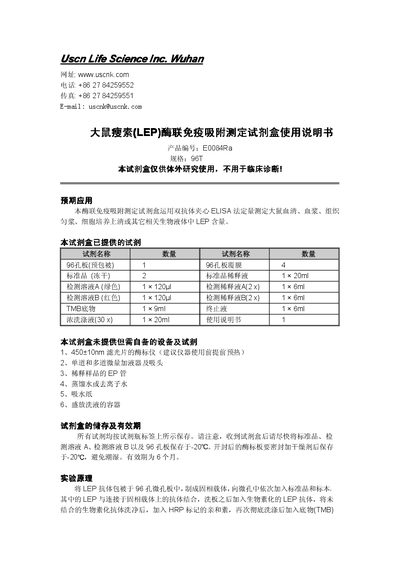
This manual describes the ELISA method for measuring rat leptin (LEP) in serum, plasma, cell culture supernatants, and tissue extracts. It lists the required reagents, plate format, and the principle of the assay, which uses a 96‑well plate coated with anti‑LEP antibodies and a biotin‑labeled detection antibody.
The document provides detailed procedures for sample preparation, reagent preparation, plate washing, incubation steps, and color development with TMB substrate. It also includes guidance on reading absorbance at 450 nm, calculating concentrations using standard curves, and storage conditions for reagents and plates. This manual is written in Chinese.
| Plate format | 96‑well plate |
|---|---|
| Detection wavelength | 450 nm |
| Detection range | 0.312 ng/mL – 20 ng/mL |
| Limit of detection | 0.079 ng/mL |
| Sample types | Serum, plasma, cell culture supernatant, tissue extract |
Read the absorbance at 450 nm.
The assay can detect leptin concentrations from 0.312 ng/mL up to 20 ng/mL.
The lowest detectable concentration is 0.079 ng/mL.
Store the reagents and plates at –20 °C (or –80 °C for long‑term) and keep the 96‑well plates sealed at –20 °C to avoid moisture.