
The 3300 XL 11mm eddy current sensor system is designed for non-contact vibration and displacement measurement of oil film bearing machines. The 11 mm probe end makes this sensor have a wider linear range than our standard 3300 XL8mm sensor system. It is mainly used in the following measurements that require a large linear range: axial (thrust) displacement measurement, steam turbine taper expansion measurement, reciprocating compressor piston rod displacement or drop measurement, tachometer and zero speed measurement, phase reference (key phase) signal.
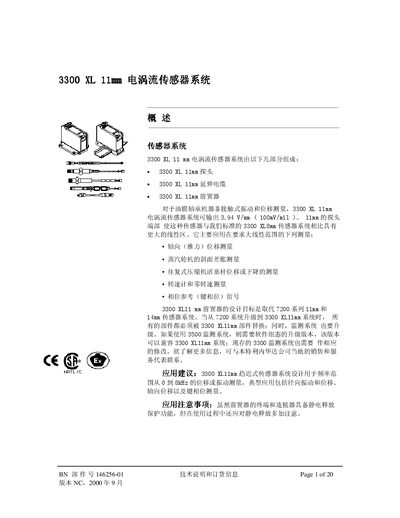
The 3300 XL 11mm eddy current sensor system consists of a probe, an extension cable, and a preamplifier. It is designed for non‑contact vibration and displacement measurement on oil‑film bearing machinery, supporting applications such as axial thrust displacement, steam turbine slope measurement, and piston rod displacement.
The document lists the system's electrical parameters, mechanical construction, temperature and humidity limits, recommended cable lengths, linear range, and ordering options for various probe and cable configurations. This manual is written in Chinese.
| Output sensitivity | 3.94 V/mm (100 mV/mil) |
|---|---|
| Frequency response | 0 to 8 kHz, typical +0 to -3 dB |
| Maximum cable length (pre‑amplifier to monitor) | 305 m (1000 ft) |
| Linear range | 4.0 mm (160 mils) |
| Output impedance | 50 Ω |
| Cable capacitance | 69.9 pF/m |
The sensor outputs 3.94 V per millimeter (100 mV per mil).
The maximum recommended length is 305 m (1000 ft).
The system has a frequency response from 0 to 8 kHz with typical attenuation of +0 to –3 dB.