
This product is an in vitro diagnostic drug used for the analysis of lymphocyte surface antigens and the measurement of suppressor/cytotoxic T cells.
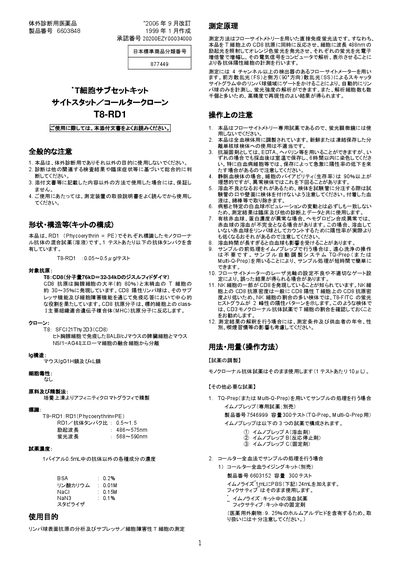
The T8‑RD1 kit contains a mixture of monoclonal antibodies labeled with Phycoerythrin (PE) that target the CD8 antigen on T‑cells. Each test vial provides 0.05‑0.5 µg of antibody and includes reagents such as BSA (0.2 %), NaCl (0.15 M), and azide (0.1 %). The kit is intended for flow‑cytometric analysis of lymphocyte surface antigens and measurement of suppressor T‑cell activity.
The manual describes how to prepare samples, perform the immunofluorescence reaction, and acquire data on a flow cytometer with at least four detection channels. It includes detailed precautions (e.g., do not use with a light microscope, handle azide with care), storage instructions (refrigerated 2‑8 °C, protect from light), and interpretation guidelines for CD8‑positive cell percentages and absolute counts. This manual is written in Japanese.
| Excitation wavelength | 486‑575 nm |
|---|---|
| Emission wavelength | 568‑590 nm |
| Antibody protein ratio (RD1) | 0.5‑1.5 |
| Antibody amount per test | 0.05‑0.5 µg |
It is used to analyze lymphocyte surface antigens and measure suppressor T‑cell (CD8) activity by flow cytometry.
Store the unopened kit refrigerated at 2‑8 °C, protect from strong light, and do not freeze.
Use an excitation wavelength of 486‑575 nm and detect emission at 568‑590 nm.