
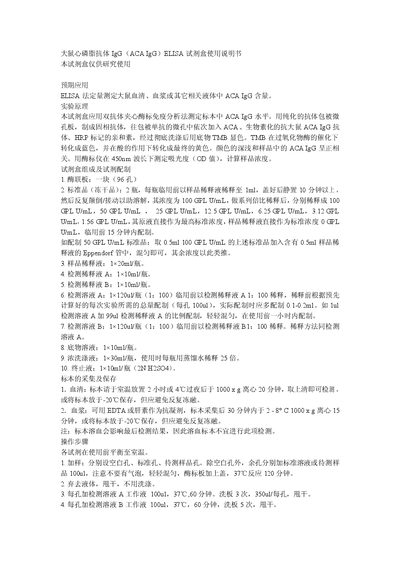
This manual describes the intended application, principle, and components of the CACA IgG ELISA kit for detecting rat anticardiolipin antibodies. It includes detailed procedures for sample preparation, reagent preparation, incubation steps, washing, and color development.
Additional sections cover specificity, calculation of concentrations, storage conditions, and safety notes to ensure reliable results and proper handling of the kit reagents. This manual is written in Chinese.
| Detection range | 1.56 GPL U/mL – 100 GPL U/mL |
|---|---|
| Plate format | 96‑well microtiter plate |
| Storage temperature | -20 °C for some reagents; 2‑8 °C for others |
The kit can detect concentrations from 1.56 GPL U/mL up to 100 GPL U/mL.
Serum samples may be kept at room temperature for 2 hours or at 4 °C overnight, then centrifuged; for longer storage, keep at –20 °C and avoid repeated freeze‑thaw cycles.
After each incubation, wash the plate three to five times with 350 µL per well, then tap dry before proceeding to the next step.
Add 90 µL of substrate per well and incubate at 37 °C in the dark for 30 minutes.