
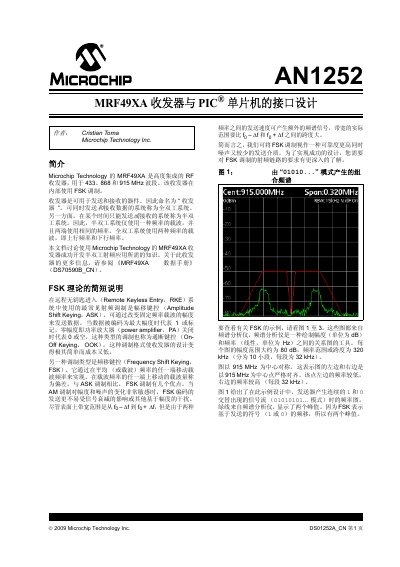
The document introduces the highly integrated MRF49XA RF transceiver, which operates in the 433 MHz, 868 MHz and 915 MHz ISM bands. It describes the modulation options (FSK, OOK, ASK) and provides the theoretical background for frequency‑shift keying.
It also details the 4‑wire SPI control interface (SDO, SDI, CLK, CS), FIFO operation, data‑rate considerations, frequency‑deviation calculations, and includes a short FAQ and source‑code availability information. This manual is written in Chinese.
| Supported frequency bands | 433 MHz, 868 MHz, 915 MHz |
|---|---|
| Typical data rate (example) | 9.6 kbps |
| Minimum frequency deviation | 30 kHz |
| Maximum frequency deviation | 200 kHz |
| Crystal tolerance | 40 ppm |
| SPI interface pins | SDO, SDI, CLK, CS |
Measure the CLKOUT pin (pin 8) with a frequency counter; avoid probing the RFXTAL pin because it can affect the measurement.
A hardware fault can cause one‑way transmission; both units must use the same crystal and configuration for full duplex operation.
No special RF tools are required; the transceiver can be evaluated with standard measurement equipment.