
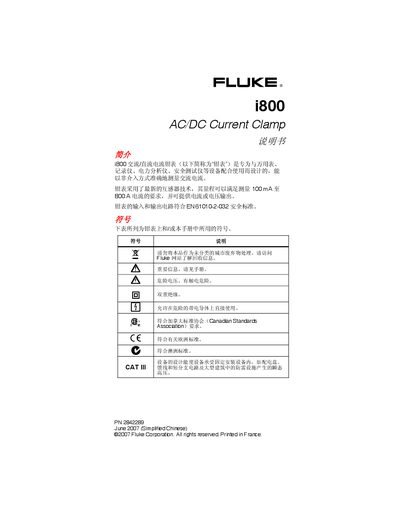
This Simplified Chinese instruction manual covers the Fluke i800 AC/DC current clamp, an accessory built with current-transformer technology for use with multimeters, recorders, power analyzers and safety testers to measure AC current non-intrusively. The clamp covers a continuous range of 100 mA to 800 A RMS and provides current output; its input and output circuits meet the EN61010-2-032 safety standard.
The manual explains safety precautions, the patented SIAC (Safety Integrated Anti-Short Circuit) mechanism, how to connect the clamp and interpret readings (the meter reading is one thousandth of the actual conductor current), and how to measure currents below 100 mA by passing multiple turns through the jaw. It also covers maintenance, cleaning, performance verification, full electrical and general specifications, safety and EMC standards, and Fluke's limited warranty. This manual is written in Chinese.
| Current range | 800 A RMS |
|---|---|
| Continuous measurement range | 100 mA to 800 A RMS |
| Overload capacity | 1500 A RMS (50/60 Hz), 1 hour at 33% duty cycle |
| Output sensitivity | 1 mA/A |
| Turns ratio | 1000:1 |
| Load impedance | ≤ 20 Ω |
| Phase shift at 2 kHz | ±1 degree |
| Frequency range | 30 Hz to 10 kHz (-3 dB) |
| Working voltage | 600 V AC RMS or DC |
| Maximum conductor size | 54 mm diameter |
| Output connection | 4 mm safety plug |
| Operating temperature | -10 to +55 °C |
| Storage temperature | -40 to +70 °C |
| Operating humidity | 15% to 85% (non-condensing) |
| Weight | 650 g |
| Cable length | 1.6 m |
When the clamp is connected to a compatible meter and clamped around a single live conductor, the reading is one thousandth of the actual current; for example, 5 A input becomes 5 mA output. Readings displayed in amperes must be multiplied by 1000 to get the conductor current in amperes.
Wind multiple turns of the input wire through the jaw so that the summed current exceeds 100 mA; the actual current equals the meter reading divided by the number of turns.
The patented SIAC (Safety Integrated Anti-Short Circuit) prevents short circuits between adjacent primary conductors by isolating the magnetic circuit at the bottom of the jaw before the upper jaw opens; a push-resistance feel should always be present when opening the jaw.
No calibration adjustment is required. Accuracy can be verified against a 20 A (±0.2%), 60 Hz current standard such as the Fluke 5100B or 5220A, and the probe should measure 20.00 A ± 0.40 A when used with a suitable digital multimeter.