
TB62757FUG is a white LED driver DC/DC converter from Toshiba. Main features include: external resistor adjustable LED current IF, support 2-6 white LED serial lighting, maximum efficiency 87% (recommended component), built-in output overvoltage protection circuit, working voltage 2.8~5.5 V.
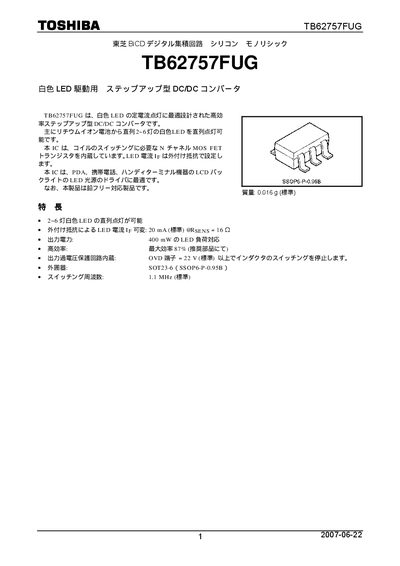
TB62757FUG is a step‑up DC‑DC converter designed for constant‑current driving of white LEDs, suitable for applications such as LCD backlights in PDAs and mobile terminals. It integrates an N‑channel MOSFET and supports 2‑6 LEDs in series with a standard LED current of 20 mA.
The document provides a block diagram, pin configuration, recommended component values, PWM dimming guidelines, and usage notes including over‑voltage protection (OVD pin) and thermal design considerations. This manual is written in Japanese.
| Output power | 400 mW |
|---|---|
| Maximum efficiency | 87 % |
| Switching frequency | 1.1 MHz |
| Operating voltage (VN) | 2.8‑5.5 V |
| LED current (IF) | 20 mA (standard) |
| Over‑voltage protection threshold | 22 V |
| Package | SOT23‑6 (SSOP6‑P‑0.95B) |
| Number of series LEDs supported | 2‑6 |
The device can drive 2 to 6 white LEDs in series.
A PWM frequency of 100 Hz to 10 kHz is recommended.
The standard LED current (IF) is set to 20 mA using an external resistor.