
This manual introduces the use of the VetScreen Influenza A/H1N1 kit produced by Hikon Life Sciences Co., Ltd. The kit is used to detect influenza A/H1N1 virus in clinical samples and environmental samples.
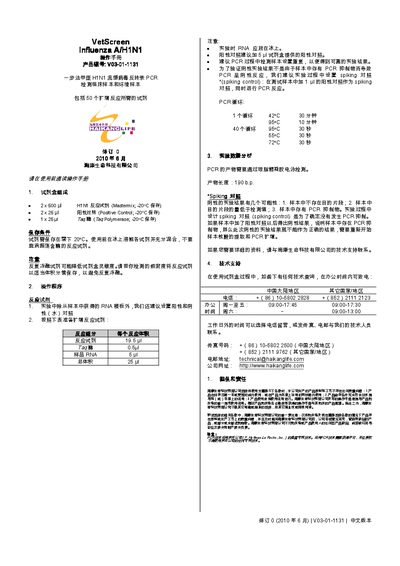
The VetScreen Influenza A H1N1 test kit provides all reagents needed for 50 RT‑PCR reactions to detect H1N1 virus in clinical or environmental samples. The kit includes Mastermix, positive control and Taq polymerase, which must be stored at –20 °C and thawed on ice before use.
The document outlines the recommended reaction setup (25 µl total volume), PCR cycling conditions, and data analysis by agarose gel electrophoresis. It also explains the use of spiking controls to identify PCR inhibition and provides technical support contact information. This manual is written in Chinese.
| Number of reactions per kit | 50 |
|---|---|
| Reagent storage temperature | -20 °C |
| Reaction volume per test | 25 µl |
| PCR cycling conditions | 42 °C 30 min; 95 °C 10 min; 40 cycles of 95 °C 30 s, 55 °C 30 s, 72 °C 30 s |
| Reagent component volumes per reaction | 2 × 500 µl Mastermix, 2 × 25 µl Positive Control, 1 × 25 µl Taq Polymerase |
Reagents must be kept at –20 °C and thawed on ice before mixing; avoid vortexing the enzyme‑containing reagents.
The program is 42 °C for 30 min, 95 °C for 10 min, then 40 cycles of 95 °C for 30 s, 55 °C for 30 s, and 72 °C for 30 s.
The kit contains enough reagents for 50 amplification reactions.
Add 1 µl of the positive control to the sample as a spiking control; if the spiked sample remains negative, PCR inhibition is suspected and the test should be repeated.