
Key facts
- Brand
- Rohde
- Model
- TS 20
- Category
- Other
- Industry
- Industrial
- Documents
- 2
- Languages
- EN · DE
- Last added
- 2026-11-09
Start here
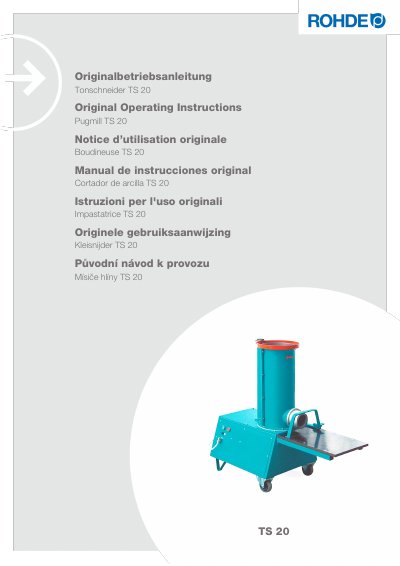
ROHDE TS 20 Pugmill Operating Instructions
The ROHDE TS 20 is a robust and durable pugmill designed for processing ceramic masses and clay. Constructed from non-rusting stainless steel, it features a large mixing cylinder and a detachable workbench with a cutting device. The machine is suitable for kneading, mixing, and preparing materials to achieve high homogeneity for further processing.
This manual provides comprehensive guidance on the safe use of the device, including specific safety warnings regarding rotating parts and electric shock. It details the installation process, operation procedures, cleaning instructions for the mixing cylinder, maintenance intervals, and troubleshooting tips for various malfunctions. This manual is written in German.
ROHDE TS 20 specifications
| Motor performance | 1,5 kW at 1400 U/min |
|---|---|
| Electric connection | 230 Volt / 16 A |
| Strang diameter | 80 mm |
| Maximum throughput | 600 kg/h |
| Height | 1100 mm |
| Width | 550 mm |
| Depth | 1100 mm incl. shelf |
| Noise level | 76 dB (A) |
| Worm gear motor speed | 14 rpm at the input shaft |
| Transmission oil | 0.5 liters of commercially available synthetic transmission oil, SAE 85 W 90 |
| Transmission oil change interval | Every 4,000 operating hours or after 4 years at the latest |
All ROHDE TS 20 documents by type
Day-to-day operation, settings and troubleshooting. Start here if the product is already set up.
Questions answered in these manuals
What materials can the ROHDE TS 20 process?
It processes and homogenizes clays and porcelain masses, and can mix different masses together and mix in fireclays. It is not suitable for processing clay flour with water.
What should I check after switching on the ROHDE TS 20?
Check that the rotating direction of the output shaft matches the red arrow on the mixing rod. If it does not, an electrician must switch two phases in the plug.
What safety measures are required before working on the electrical components?
Maintenance and repair work on electrical components must be carried out exclusively by qualified electricians.
How many people are required for transport and assembly?
Due to the high own weight, transport and assembly should be carried out by at least two people.