
Key facts
- Brand
- ion science
- Model
- GasClam 2
- Documents
- 5
- Languages
- EN
- Last added
- 2023-10-18
Start here
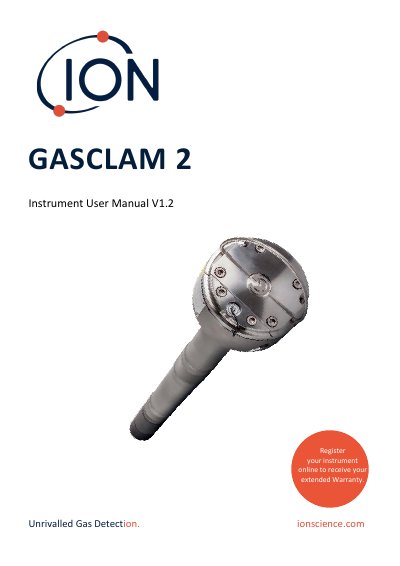
Ion Science GasClam 2 Instrument User Manual
The Ion Science GasClam 2 is the world's first in-situ continuous borehole gas monitor and logging instrument. It is designed to detect and record the concentration of a wide range of gases, including Methane, Carbon Dioxide, Oxygen, Carbon Monoxide, Hydrogen Sulphide, and Volatile Organic Compounds. In addition to gas concentrations, the instrument records temperature, barometric pressure, and borehole pressure. An optional water level sensor can also be fitted to measure fluctuations in the water table. The device is built from stainless steel, is intrinsically safe, and is certified for use in explosive environments in hazardous zone 1 with an IP68 protection code.
Read onlineIon Science GasClam 2 specifications
| Gas Sensor Specifications | Methane (CH4), Carbon Dioxide (CO2), Oxygen (O2), Carbon Monoxide (CO), Hydrogen Sulphide (H2S), Volatile Organic Compounds (VOC) |
|---|---|
| Operating Temperature | Below 0°C |
| Battery Life | Approximately one month (standard batteries), up to 3 months (long-life Lithium batteries) |
| Certification | Intrinsically safe, IP68, Zone 1 hazardous area |
All Ion Science GasClam 2 documents by type
Day-to-day operation, settings and troubleshooting. Start here if the product is already set up.
Questions answered in these manuals
How long does the GasClam 2 last on battery?
It lasts approximately one month on standard batteries, up to 3 months with long-life Lithium batteries.
Can the GasClam 2 be used in hazardous areas?
Yes, it is certified for use in hazardous zone 1 and is intrinsically safe.
How long does the GasClam 2 operate on batteries?
The default setting takes a sample every hour, giving approximately one month of operation with standard batteries, extendable to 3 months with optional long-life Lithium batteries.
Can the GasClam 2 be used in hazardous areas?
Yes, it is certified for use in hazardous zone 1 and is intrinsically safe.
What gases can the GasClam 2 detect?
It detects Methane, Carbon Dioxide, Oxygen, Carbon Monoxide, Hydrogen Sulphide, and Volatile Organic Compounds.
Can the GasClam 2 be used in hazardous areas?
Yes, it is intrinsically safe and certified for use in explosive environments in hazardous zone 1.