
Key facts
- Brand
- GFG
- Model
- CS21
- Documents
- 2
- Languages
- EN
- Last added
- 2023-10-26
Start here
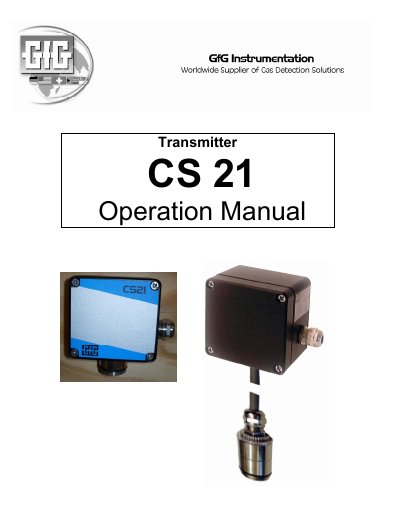
GfG CS21 Transmitter Operation Manual
This manual provides instructions for safely installing, calibrating, and maintaining the GfG CS21 gas transmitter. It covers mounting position, electrical connections, zero point and sensitivity checks, and troubleshooting. The CS21 uses chemosorption principle to convert gas concentration into 0.2–1 mA or 4–20 mA signals. Calibration and adjustments must be performed after warm-up and only with authorized methods or tools.
Read onlineGfG CS21 specifications
| Output Signal | 0.2 .. 1 mA or 4 .. 20 mA |
|---|---|
| Supply Voltage | 10 .. 32 V DC |
| IP Rating | IP 54 |
All GfG CS21 documents by type
Day-to-day operation, settings and troubleshooting. Start here if the product is already set up.
Questions answered in these manuals
What is the output signal range of the CS21 transmitter?
The output signal is 0.2 to 1 mA or 4 to 20 mA, depending on the interface selected.
How do I check the electrical zeropoint of the CS21?
After a warm-up time of approx. 30 minutes, measure the voltage at the test contacts; it should be approx. 200mV, corresponding to 0.2 mA or 4 mA.
How do I check the electrical zero point of the CS21?
After a warm-up time of approx. 30 minutes, measure the voltage at the test contacts; it should be approx. 197 mV, corresponding to 4 mA output (4–20 mA interface).
What is the required warm-up time before checking the sensitivity of the CS21?
The chemosorption sensor requires a running-in time of approximately 15 to 30 minutes before you can check the sensitivity.