
Package insert for Zhejiang Medicine Cefradine Capsules, covering ingredients, indications, dosage, adverse reactions, contraindications, precautions and…
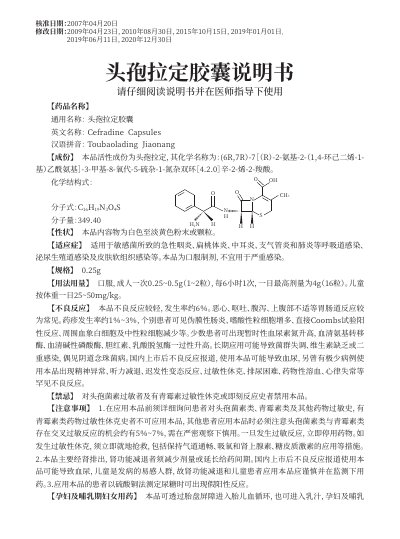
This is the Chinese package insert (说明书) for Cefradine Capsules, a first-generation cephalosporin oral preparation. It lists the drug name in Chinese, English (Cefradine Capsules) and pinyin (Toubaolading Jiaonang), the active ingredient cephradine with its chemical name and molecular formula, and describes the contents as a white to pale yellow powder or granules.
The leaflet sets out the indications for infections caused by susceptible bacteria, the strength, oral dosage for adults and children, adverse reactions, contraindications, precautions, use in pregnant and breastfeeding women, children and the elderly, drug interactions, pharmacology and toxicology, pharmacokinetics, storage, packaging, shelf life, pharmacopoeia standard and approval number. The manufacturer is Zhejiang Medicine Co., Ltd. Xinchang Pharmaceutical Factory, Shaoxing, Zhejiang. This manual is written in Chinese.
| Active ingredient | Cefradine (头孢拉定) |
|---|---|
| Appearance of contents | White to pale yellow powder or granules |
| Pharmacological class | First-generation cephalosporin |
| Route of administration | Oral |
It is indicated for respiratory tract infections such as acute pharyngitis, tonsillitis, otitis media, bronchitis and pneumonia caused by susceptible bacteria, as well as urinary and genital tract infections and skin and soft tissue infections.
It is contraindicated in people allergic to cephalosporins and in those with a history of penicillin anaphylactic shock or immediate reaction.
Adverse reactions are described as mild; gastrointestinal reactions such as nausea, vomiting, diarrhea and upper abdominal discomfort are relatively common.
It should be used with caution, because it can cross the placental barrier into the fetal circulation and also enter breast milk.