
User manual for YOUNG TECH YT-520/YT-525 pneumatic directional control valves, covering installation, operation, maintenance, and troubleshooting.
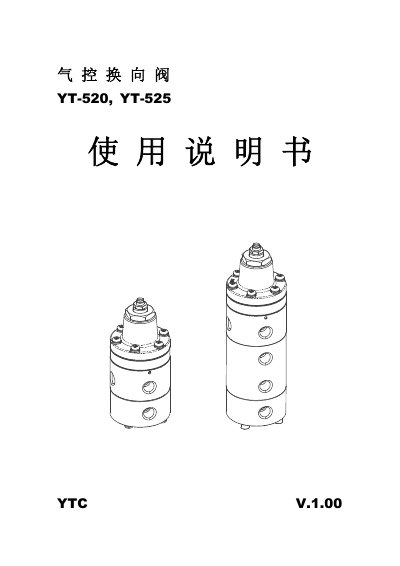
This manual provides detailed instructions for installing, operating, and maintaining the YOUNG TECH YT-520 and YT-525 pneumatic directional control valves. It covers product features, selection methods, technical specifications, working principles, installation procedures, maintenance, troubleshooting, and warranty information. The valves are designed to control air flow direction based on signal pressure compared to a set pressure, offering protection in case of compressor failure or air leakage. Installation requires dry, non-corrosive air and proper pressure adjustment using a pressure gauge. This manual is written in Chinese.
| Maximum Supply Pressure | 1MPa (10bar) |
|---|---|
| Signal Pressure Range | 0.14~0.7MPa (1.4~7.0bar) |
| Flow (Cv) | 0.9 |
| Sensitivity | 0.01MPa (0.1bar) |
| Operating Temperature Range | -20℃~70℃ (standard), -40℃~120℃ (option) |
| Material | Die-cast aluminum or stainless steel 316 |
| Weight | 0.5kg (YT-520S), 0.8kg (YT-525S), 1.3kg (YT-520D), 1.6kg (YT-525D) |
The default setting pressure is 3 kgf/cm².
Check if the setting pressure is correct. If it is set too high, lower it.
It indicates a damaged diaphragm assembly or leak. Replace the diaphragm assembly.