
Manual for Vickers EEA-PAM-5**-F-32 power amplifier with CNC adapter, covering features, wiring, setup and operation.
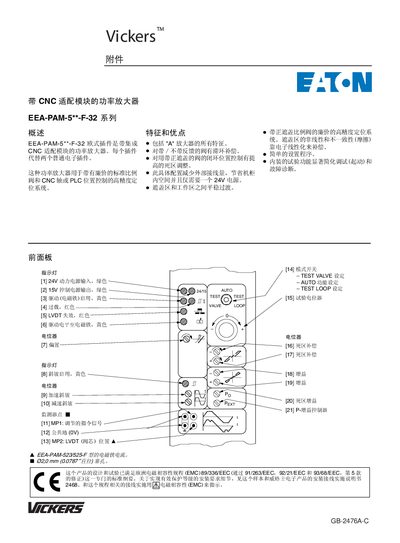
The Vickers EEA-PAM-5**-F-32 series is a power amplifier with an integrated CNC adapter module, designed for high‑precision positioning systems that use standard proportional valves and CNC or PLC controllers. The document describes the amplifier’s features, wiring connections, test functions and installation requirements.
Key sections include a front‑panel description, wiring diagrams, input and output specifications, test‑mode operation, alarm output behavior, environmental limits and an application example showing how to connect the amplifier to a CNC axis controller. This manual is written in Chinese.
| Power input voltage | 24 V |
|---|---|
| Control output voltage | 15 V |
| Input impedance (voltage) | 47 kΩ @ ±10 V |
| Input current range | ±20 mA (100 kΩ) |
| Alarm output maximum current | 50 mA |
| Operating temperature range | –25 °C to +85 °C |
| Weight | ≈0.4 kg |
Use the 3‑position mode switch on the front panel: AUTO for automatic operation, TEST VALVE for open‑loop valve testing, and TEST LOOP for closed‑loop loop testing.
Dead‑zone compensation adjusts the control for valves with positive overlap, improving closed‑loop position control accuracy.