
The ShineGene pGEM‑T vector manual explains its features and provides step‑by‑step cloning, transformation, and screening procedures.
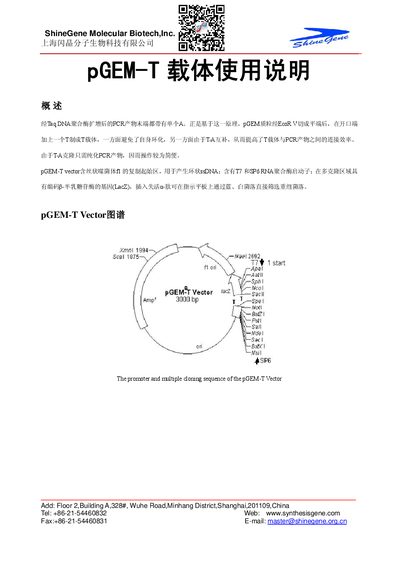
The pGEM‑T vector is a T‑A cloning plasmid that contains an f1 origin for ssDNA production, T7 and SP6 promoters, and a LacZ α‑fragment for blue/white colony screening. It is supplied at 50 ng/µl concentration and is designed for efficient ligation of PCR products with 3′‑A overhangs.
The manual details the ligation reaction (mixing vector, purified PCR product, T4 ligase and buffer, incubating at 16 °C or 4 °C overnight), the transformation of competent JM109 or DH5α cells (heat‑shock at 42 °C for 90 s), and the identification of recombinant colonies (white colonies indicate inserts; confirmation by PCR, restriction analysis, or sequencing). This manual is written in Chinese.
| Vector concentration | 50 ng/µl |
|---|---|
| Promoters | T7 and SP6 RNA polymerase promoters |
| Origin of replication | f1 phage origin for ssDNA production |
Mix 50 ng of pGEM‑T vector with 10‑50 ng purified PCR product, add 2‑3 µl T4 ligase, 1 µl 10× ligation buffer, and water to a total volume of 10 µl, then incubate at 16 °C or 4 °C overnight.
White colonies on LB plates containing Amp, IPTG, and X‑Gal indicate insertion of the PCR fragment; they can be further verified by PCR, restriction digestion, or sequencing.