
This manual covers the setup, operation, and care of the Sennheiser ew 100 wireless transmission system, including various transmitter and receiver variants.
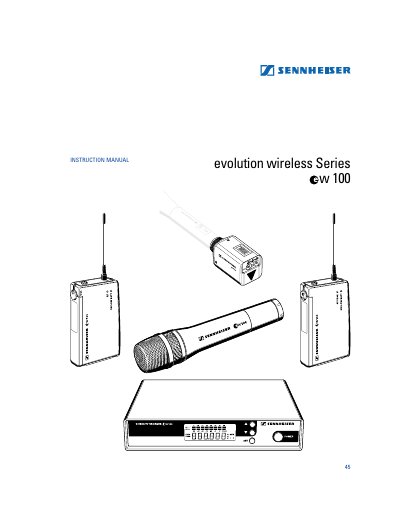
The Sennheiser ew 100 series offers musicians and audio amateurs high-quality RF transmission systems with operational reliability and ease of use. The systems feature optimized PLL and microprocessor technology, the HDX noise reduction system, and true diversity technology to ensure interference-free transmission and minimized dropouts. They are available in five frequency ranges within the UHF band (Range A: 518–550 MHz, Range B: 630–662 MHz, Range C: 740–772 MHz, Range D: 790–822 MHz, Range E: 838–870 MHz) and are 4-channel switchable with 4 frequency memories.
| Frequency Ranges | Range A: 518 – 550 MHz, Range B: 630 – 662 MHz, Range C: 740 – 772 MHz, Range D: 790 – 822 MHz, Range E: 838 – 870 MHz |
|---|---|
| Channel Switching | 4-channel switchable |
| Frequency Memories | 4 frequency memories |
| Frequency Step | 25-kHz steps |
| Frequency Selection | 1280 frequencies |
| Noise Reduction | HDX noise reduction system |
| Reception Technology | True diversity technology |
The system is available in five frequency ranges within the UHF band: Range A (518–550 MHz), Range B (630–662 MHz), Range C (740–772 MHz), Range D (790–822 MHz), and Range E (838–870 MHz).
The ew 100 transmitters and receivers are 4-channel switchable, with each unit having 4 frequency memories to store up to 4 transmission/receiving frequencies.
You should not use any cleansing agents or solvents, as varnish or furniture polish may degrade the rubber feet of the transmitter.
Yes, but you should not use the supplied self-adhesive soft rubber feet if you are rackmounting the receiver.